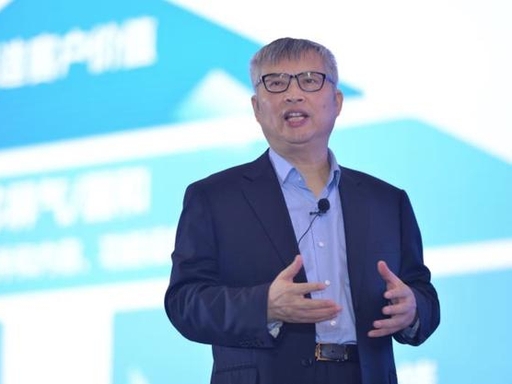
At 68, Wang Dongsheng, the man who built BOE into a global display powerhouse and helped tackle China’s “screen shortage,” is once again heading to the capital markets. ⚡
His chip company ESWIN Computing has filed its prospectus with the Hong Kong Stock Exchange for the third time, seeking to become Hong Kong’s first publicly listed RISC-V company.
The company has raised more than RMB 9 billion over the past five years while recording a combined net loss of RMB 4.9 billion over the past three years. Betting heavily on R&D to advance China’s homegrown, open-source chip architecture, ESWIN Computing is now caught between two contrasting realities: steadily rising revenue and rapidly expanding AI-compute businesses on one side, and persistent cash burn and customer concentration risks on the other.
It has become one of the most representative examples of China’s semiconductor industry entering a second round of entrepreneurship.
In 2019, at the age of 62, Wang Dongsheng stepped down from BOE. Rather than retiring, he turned his attention to another critical bottleneck: China’s shortage of advanced chips.
He founded ESWIN Computing at a time when U.S.-China technology tensions were intensifying. ARM and x86, the two dominant closed-source architectures, had long controlled the global computing-chip market. High licensing costs and technology restrictions had become major constraints on China’s semiconductor industry, making RISC-V’s open-source architecture an increasingly important route for technological self-reliance.
ESWIN assembled a high-profile R&D team, recruiting core technical talent from companies including Intel and Qualcomm.
Operating under a fabless business model, the company focuses on two major areas — smart terminals and embodied intelligence — providing a full range of RISC-V chip solutions.
Its sister company, ESWIN Materials, has already gone public on Shanghai’s STAR Market, raising RMB 4.636 billion. Now, with ESWIN Computing making its third attempt to list in Hong Kong, Wang Dongsheng’s dual focus on displays and chips is gradually taking shape.
The company’s actual controllers collectively hold 31.55% of the shares, indicating a relatively stable ownership structure.
The company’s prospectus paints a sharp contrast in its financial performance.
✅ Steady revenue growth: Revenue reached RMB 1.752 billion, RMB 2.025 billion, and RMB 2.431 billion in 2023, 2024, and 2025, respectively, representing a three-year CAGR of 19.4%. Revenue in the first quarter of 2026 reached RMB 494 million, up 18.4% year over year, while gross margin improved to 18.6%.
✅ New businesses are taking off: Revenue from computing chips surged from just RMB 3.8 million in 2023 to RMB 320 million in 2025, an increase of roughly 84.2×. Automotive and robotics AI chips are opening up a second growth curve.
❌ Losses remain heavy: The company recorded combined net losses of RMB 4.9 billion from 2023 to 2025, followed by another RMB 375 million loss in the first quarter of 2026. The main driver was massive R&D spending. From 2022 to 2024, cumulative R&D expenditure exceeded RMB 4.2 billion, while R&D personnel accounted for more than 70% of the workforce.
❌ Customer concentration remains a concern: Revenue contribution from the company’s largest customer fell from 75% to 39.3%, but dependence on major customers remains relatively high.
As of the first quarter of this year, the company had only around RMB 1.3 billion in cash on its balance sheet. At its current rate of cash burn, liquidity remains under pressure, making the fundraising potential of an IPO particularly important.
Within five years of its founding, ESWIN Computing completed four rounds of financing, attracting dozens of major institutional investors, including China Integrated Circuit Industry Investment Fund Phase II, IDG Capital, Legend Capital, and Gaorong Capital.
Its post-money valuation reportedly reached as high as RMB 35.3 billion.
Industry data also points to significant long-term potential:
Global RISC-V chip shipments exceeded 10 billion units in 2024, with China accounting for more than half of the total.
China’s embodied-intelligence chip market is projected to reach RMB 129.7 billion in 2025 and grow to RMB 387.7 billion by 2030, while RISC-V penetration is expected to rise from 6.4% to 28.2%.
ESWIN Computing is currently the largest smart-terminal human-machine interaction chip supplier in China, ranking among the top three in the domestic RISC-V main-control chip market.
With the global semiconductor and AI-compute markets running hot and China’s A-share electronics sector gaining more than 86% in the first half of the year, the current industry upcycle has created a favorable window for semiconductor companies seeking public-market funding to support R&D and capacity expansion.
RISC-V offers a combination of no architecture licensing fees and modular flexibility, making it well suited to fragmented AI applications and an important potential route for China to reduce its dependence on foreign chip architectures.
ESWIN Computing also benefits from its connection to BOE in display-chip businesses, while its automotive and robotics computing chips are positioned around the rapidly developing embodied-intelligence market.
The company therefore has notable advantages across both the upstream and downstream sides of the industry.
Long R&D cycles and uncertain profitability: Chip development requires years of investment, while meaningful returns may remain far away. Persistent losses will continue to test investors’ patience.
A major ecosystem gap: ARM and x86 have mature ecosystems, while RISC-V still faces significant challenges in commercial adoption, software compatibility, and ecosystem development.
Semiconductor cyclicality: The semiconductor industry remains highly cyclical, meaning fluctuations in downstream demand can directly affect order stability.
Customer concentration: Although dependence on its largest customer has declined significantly, reliance on major customers remains a structural risk.
From tackling China’s “screen shortage” to taking on its “chip shortage,” Wang Dongsheng’s second venture at the age of 68 is a microcosm of China’s drive toward greater technological self-reliance.
ESWIN Computing’s third attempt at a Hong Kong listing is not only a critical step toward securing fresh capital for its next stage of growth, but also a closely watched test of how far RISC-V commercialization in China can go.
The market opportunity is substantial.
But persistent cash burn, ecosystem gaps, and customer concentration remain three major hurdles that ESWIN Computing will have to overcome on its path toward profitability.

AI Market Research & Consumer Insights Provider
China's Leading Treasury Management Software Provider
AI落地解决方案及数字化创新服务提供商
A high-tech enterprise integrating product design, R&D, sales, and services.
Leading full-scenario data intelligence service provider in China.