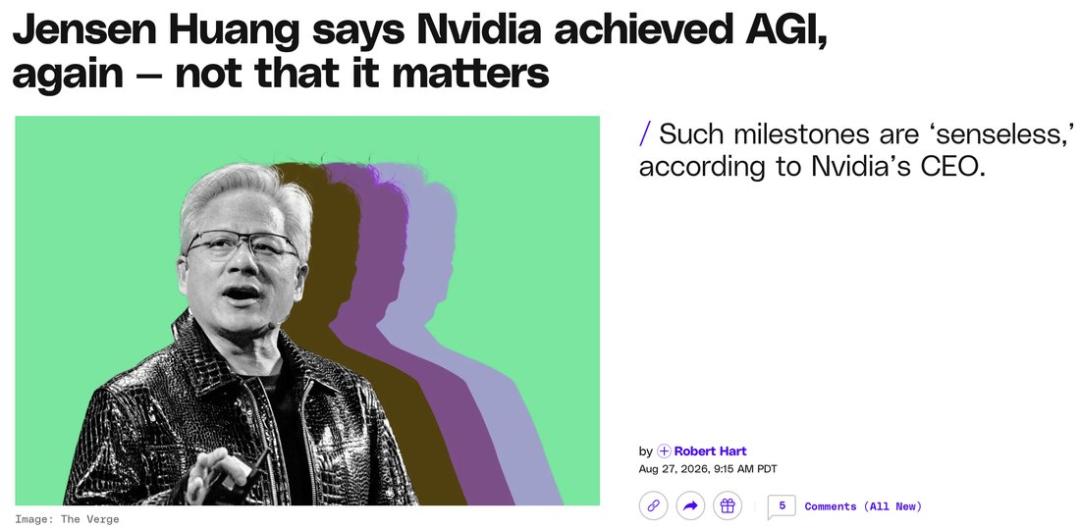
When Jensen Huang suggested on an earnings call that AGI may already have been achieved, Sam Altman gave a much more precise timeline in a lengthy interview the same day: by the end of 2026.
For Altman, the next four months are about more than a technological sprint. Before OpenAI goes public next year, he needs to put AGI on the table.
If he fails to deliver, OpenAI could be heading into its IPO with a rival already public, valued at roughly twice as much, and generating profits.
There is nowhere left for OpenAI to retreat.
During the earnings call, Huang was asked how he viewed the race toward AGI among companies such as OpenAI.
His response was cautious: the industry still cannot agree on what intelligence actually is, let alone establish a common yardstick for measuring AGI.
But Nvidia has another benchmark to point to.
Its AVO architecture reportedly achieved a perfect score on the ARC-AGI-3 test. Huang used the result to make an ambitious prediction: in the not-too-distant future, Nvidia could operate with around 40,000 human employees while commanding a digital workforce of 400,000 — or even four million.
But there is a catch.
ARC-AGI-3 is designed to throw AI agents into unfamiliar games without explaining the rules or objectives. The agents have to figure everything out by observing, experimenting and interacting with the environment.
The key detail is that AVO itself was powered by Claude Opus 5. Nvidia did not modify the model's weights. Instead, it wrapped the model with additional infrastructure, taking its performance from 30.16% to a perfect score.
The real gains came from persistent memory and supervision mechanisms.
Even more interesting: this was already the third perfect score announced within six weeks. The approaches were different, but all three systems were powered by Claude Opus 5.
More companies are claiming AGI. Yet the models apparently still come down to the same two players.
François Chollet, the creator of ARC-AGI, pushed back on Nvidia's announcement just hours after it went public. His point was straightforward: scoring 100% on a public demonstration set does not mean achieving 100% on the actual benchmark.
The private and semi-private sets are what matter — and AVO had not reported results on either.
In the interview, Altman was remarkably confident: by the end of the year, OpenAI will have an internal system that he would be willing to call AGI.
OpenAI Chief Research Officer Mark Chen was more conservative, suggesting the company is still roughly 20% away.
OpenAI does, however, appear to have something substantial in development.
One of its clearest internal goals this year has been to build an AI research intern that can actually do meaningful work.
That system is Astra.
Give Astra an experimental idea, and it can write code inside OpenAI's codebase, run experiments and deliver results. Give it a research paper, and it can reportedly complete roughly a week's worth of work that would previously have required a top human researcher.
In a recent internal demonstration, 16 AI agents broke down a research-level mathematics problem into smaller tasks, worked on them independently, cross-checked one another and ultimately assembled a complete proof.
A second demonstration was even more revealing.
Astra operated common desktop applications, moving between different programs to create files, modify content and coordinate tasks.
Altman has predicted that this could become the first model capable of independently inventing something genuinely important — producing something humanity does not yet know.
Perhaps the strongest evidence is OpenAI's first internally developed chip, Jalapeño.
The chip reportedly outperformed Nvidia's flagship GPUs, with GPT-Astra playing a major role in the development process.
Astra worked across the stack, from circuit design to software — optimizing low-level circuitry, writing core kernels and tuning three major open-source models.
Performance for a BF16 multiplier reportedly increased by 56%, while the area occupied by the matrix unit decreased by 10%.
In other words, AI was no longer simply writing software.
It was helping redesign the hardware itself.
Interestingly, Nvidia is working on something remarkably similar.
AVO's primary battlefield is low-level GPU code. A paper published in March described an approach in which the process of modifying and optimizing code was handed over to an autonomous agent.
In testing, the agent reportedly ran autonomously for seven days without human intervention, exploring more than 500 optimization directions.
Put the two developments together, and Altman's confidence starts to make more sense.
Every new model iteration traditionally consumes enormous amounts of human research time.
If Astra can take over a meaningful portion of that work, the pace of AI development could change dramatically.
Once that loop starts running, the remaining question becomes speed.
The publicly available GPT-5.6 and Fable 5 models are products of the previous generation.
According to reports, both companies have already completed training on their next-generation models.
OpenAI's pre-training schedule this year has been particularly aggressive.
Spud, or Sol, reportedly completed pre-training in March, forming the foundation for the current GPT-5.5 and GPT-5.6 generation.
Doug completed pre-training between April and May. After reinforcement learning and other post-training work, it is expected to become Astra — what some observers are calling GPT-6.
Then there is Bel, which reportedly completed pre-training in August with more than 10 trillion parameters.
Internally, OpenAI is said to view Bel as a foundation model beyond GPT-6, potentially serving as the base for a model capable of crossing the AGI threshold.
Anthropic appears to be moving just as quickly.
On August 18, users noticed that some Claude accounts had quietly been switched to a new model. Soon after, model identifiers began circulating online.
claude-melon-eap was reportedly linked to Fable 5.1, while claude-marshmallow-eap was suspected to be Opus 5.1.
Both models are reportedly already running in limited testing and could be rolled out more broadly.
Why keep them under wraps?
One theory circulating online is simple: whoever launches first could be overtaken by the other within days.
Anthropic has also reportedly been positioned by some analysts as capable of taking the lead in early 2027.
That leaves a very specific window for the current AI race:
The final four months of 2026.
Some institutional estimates have put Anthropic's potential IPO ahead of OpenAI's, with October 26, 2026 cited as a possible date for Anthropic and July 15, 2027 for OpenAI.
Those same estimates have placed potential first-day valuations at around $1.82 trillion for Anthropic and $1.06 trillion for OpenAI.
That makes AGI by year-end more than a technological milestone.
It could become one of the most important pages in OpenAI's IPO story.
If OpenAI delivers, the narrative changes from a company spending enormous amounts of money to build increasingly powerful models to a company claiming to have reached the threshold it has been building toward.
If it doesn't, OpenAI could enter its IPO still carrying the same capital-intensive growth story.
And the deeper reason this race matters comes down to four words:
Recursive self-improvement.
Huang's vision of 40,000 humans directing millions of AI agents and OpenAI's vision of AI helping build the next generation of AI are ultimately pointing toward the same possibility.
Once AI can take over meaningful parts of the process of building better AI, progress may no longer remain linear.
The first player to make that loop work at scale could gain a compounding advantage.
And for Altman, the clock is already running.

AI Market Research & Consumer Insights Provider
China's Leading Treasury Management Software Provider
AI落地解决方案及数字化创新服务提供商
A high-tech enterprise integrating product design, R&D, sales, and services.
Leading full-scenario data intelligence service provider in China.