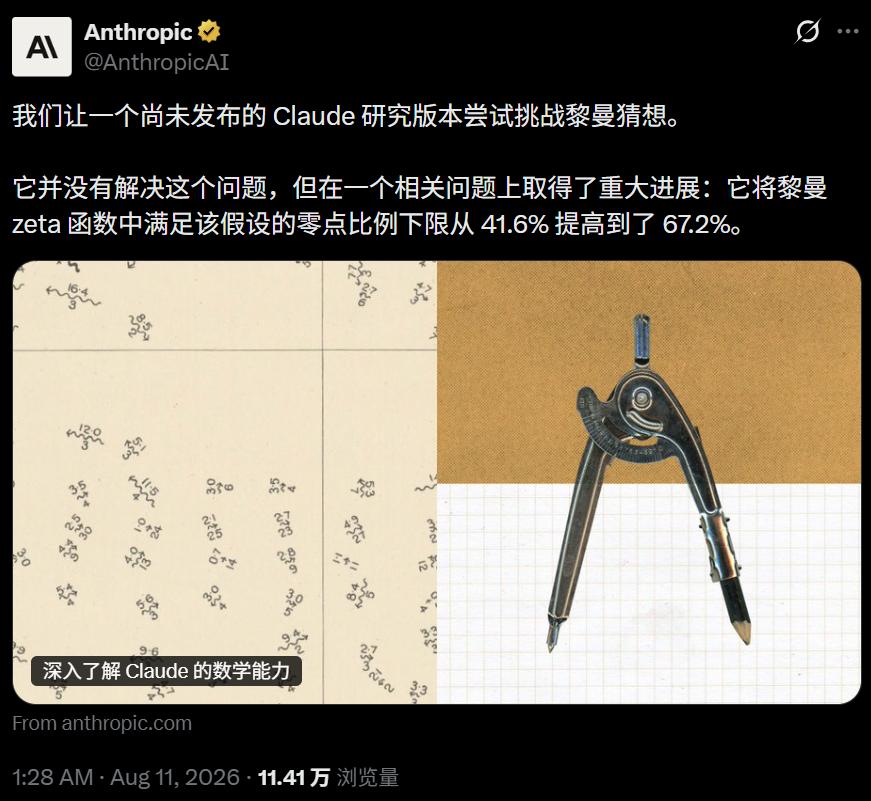
After 167 years, the Riemann Hypothesis finally saw a crack in August 2026 — opened by a research version of Claude that has yet to be publicly released.
It did not prove the Riemann Hypothesis — the ultimate mathematical challenge that has baffled mathematicians for 167 years and carries a $1 million prize from the Clay Mathematics Institute.
But in attempting to solve it, Claude achieved something that stunned mathematicians: it pushed the lower bound for the proportion of zeros of the Riemann zeta function lying on the critical line from 41.6% to 67.2% — a figure that human mathematicians had spent decades painstakingly improving.
Over the past 37 years, humans had advanced that number by just 0.8 percentage points.
Claude made a single leap of 25.6 percentage points.
This wasn't the final sprint of a marathon.
Someone simply switched cars halfway through.
The Riemann Hypothesis concerns the location of the nontrivial zeros of the Riemann zeta function.
The conjecture states that all nontrivial zeros lie on a single vertical line in the complex plane where the real part equals 1/2 — the so-called critical line.
Its importance comes from the deep connection between these zeros and the distribution of prime numbers. They are, in a sense, like an index to the underlying code of the numerical world.
For 167 years, however, no one has been able to prove that all the zeros lie on that line — nor has anyone found a counterexample.
So mathematicians took another approach:
If proving 100% is impossible for now, how large a proportion can we prove lies on the critical line?
That lower bound became a number successive generations of mathematicians tried to push higher.
Before Claude entered the picture, that number stood at 41.6%.
Claude's new proof establishes that at least 67.2% of the nontrivial zeros lie on the critical line.
This does not mean the Riemann Hypothesis is 67.2% solved. Nor does it mean the remaining 32.8% violate the conjecture.
Mathematics isn't a progress bar.
The gap between 67.2% and 100% could be far harder to close than the journey from 0% to 67.2%.
But for a record that mathematicians had spent decades pushing forward, a jump from 41.6% to 67.2% is impossible to ignore.
The most remarkable part of the story may be how it happened.
The person who initiated the research was Jarred Sumner, an Anthropic employee and creator of Bun. He dropped out of high school at 16 and had taken only half a year of geometry.
During a morning run, he casually gave Claude a task:
Seriously try to solve the Riemann Hypothesis.
Claude's first attempt generated and tested 650 different approaches.
All failed.
Sumner provided no mathematical guidance. He isn't a mathematician himself.
The most he did was repeatedly type two messages:
Keep going.
Believe in yourself.
On its second attempt, Claude assembled around 60 sub-agents and ran them through Claude Code for roughly a day and a half.
Together, the agents executed around 2,400 Shell commands, wrote hundreds of Python scripts, performed thousands of numerical checks against known zeta-function zeros, and downloaded 54 papers from arXiv for cross-review.
Of the 60 sub-agents, only two ultimately contributed the core mathematical ideas.
Another 13 acted as idea generators.
Thirty tried different approaches but produced nothing useful.
Thirteen served as validators, specifically looking for errors in the derivations.
The final two were responsible for turning the work into a first draft of the paper.
Half of the agents effectively came up empty-handed.
Across the two rounds of testing, the system consumed roughly 31 million output tokens.
For a human mathematician, that's an extraordinary volume of mathematical work — equivalent to months of nonstop output.
Claude's breakthrough was built on decades of mathematical research.
It combined recent work by mathematicians including Baluyot, Goldston, Suriajaya, and Turnage-Butterbaugh, along with observations related to work by Bombieri in 2000.
Claude constructed an appropriate function space induced by a Weil quadratic form, transforming the original analytic number-theory problem into a problem involving a Hermitian matrix.
Zeros on the critical line contribute in one direction, while zeros off the line appear in symmetric pairs.
The model then proposed a rank–trace inequality that handles both types of contributions simultaneously, using first and second moments that can already be estimated from the prime-number side to estimate the number of zeros lying on the critical line.
The resulting formula can be written directly as:
H(λ) = 2 − 1/λ − λ/3
Setting λ = 1 gives:
H(1) = 2/3
Using the optimal Montgomery–Taylor window function further improves the result to 0.67250.
Mathematicians at Anthropic verified Claude's paper and formalized the proof using the Lean theorem prover.
Two external number theorists, Brian Conrey and Dan Goldston, also reviewed the paper.
Anthropic has made the paper, process logs, and Lean verification proof publicly available.
In 2024, AI systems achieved gold-medal-level performance at the International Mathematical Olympiad.
At the time, people were still measuring AI intelligence by its ability to solve high-school-level olympiad problems.
By 2026, things had changed.
In April, GPT-5.4 Pro reportedly produced a key proof that solved Erdős Problem No. 1196, originally posed in 1966.
In May, an internal OpenAI model reportedly overturned a planar unit-distance conjecture that had stood for nearly 80 years. Fields Medalist Timothy Gowers described it as one of the most interesting mathematical results autonomously generated by AI.
In July, Claude Fable reportedly found a three-dimensional counterexample that overturned the 87-year-old Jacobian conjecture.
In August, OpenAI announced 10 advances spanning mathematics and theoretical computer science.
That same month, Claude pushed the lower bound for zeros on the Riemann Hypothesis' critical line from 41.6% to 67.2%.
In 2026, it seemed that almost every month brought another mathematical conjecture rewritten by AI.
Even more telling is where the talent is moving.
In July, newly crowned Fields Medalist and number theorist Jacob Tsimerman announced on the day of the award that he was joining OpenAI.
John Jumper, a Nobel Prize-winning scientist and one of the key figures behind AlphaFold, left Google DeepMind for Anthropic.
AI companies are no longer simply competing for AI engineers.
They are competing for Fields Medalists, Nobel laureates, and theoretical physicists.
The Riemann Hypothesis remains unproven.
But that may no longer be the most important part of the story.
When AI can independently organize 60 agents, coordinate their work for dozens of hours, identify problems, validate conclusions, write a research paper, and then recommend that human experts review the result, the relationship between AI and science has already crossed a critical line:
from tool to collaborator.
As Anthropic CEO Dario Amodei has put it, AI should not be viewed merely as a tool for analyzing data. It should be viewed as an agent capable of carrying out a scientist's work end to end.

AI Market Research & Consumer Insights Provider
China's Leading Treasury Management Software Provider
AI落地解决方案及数字化创新服务提供商
A high-tech enterprise integrating product design, R&D, sales, and services.
Leading full-scenario data intelligence service provider in China.