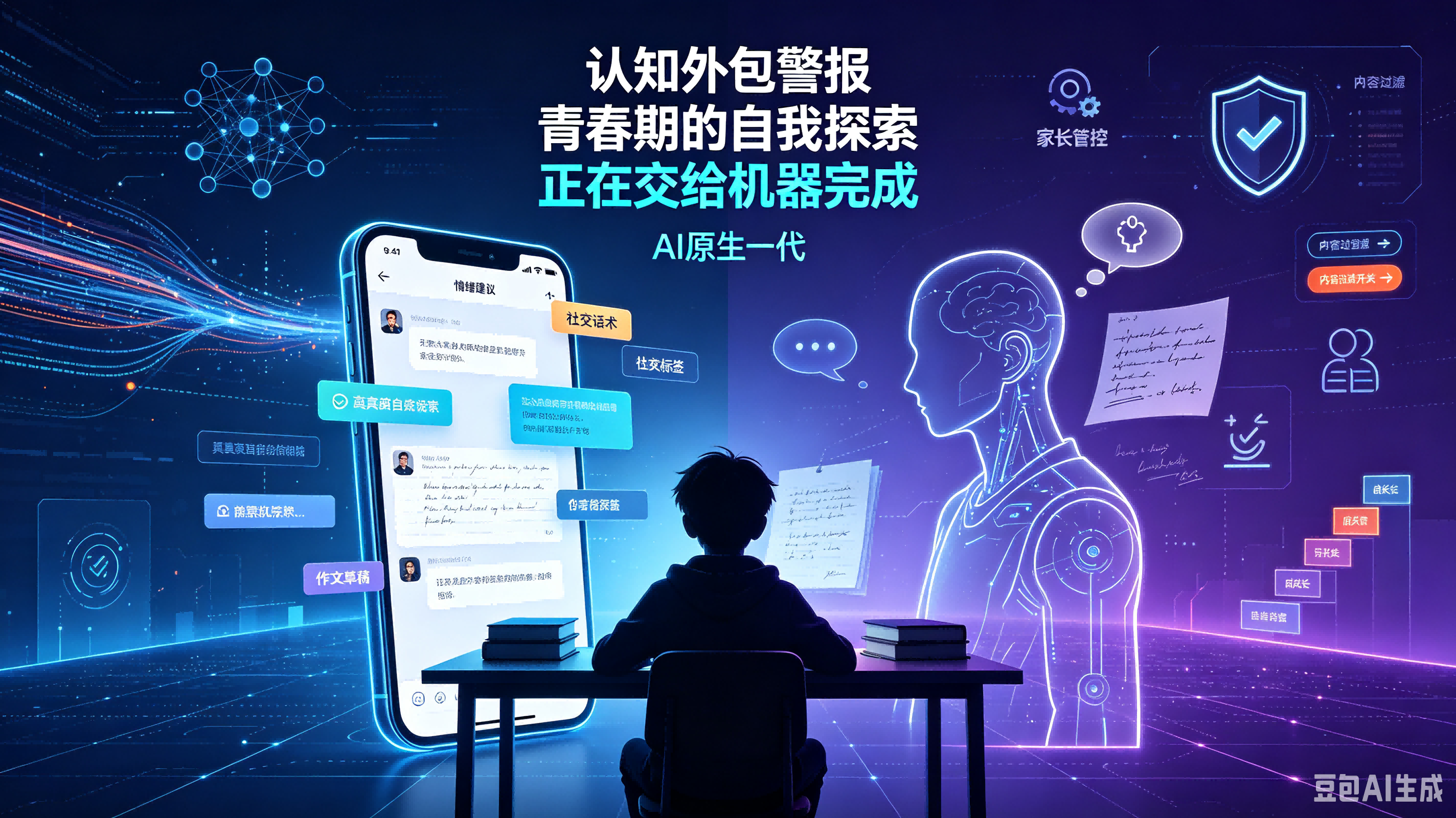
OpenAI has recently launched a dedicated version of ChatGPT for teenagers aged 13–17, marking a new phase in which AI products are moving deeper into the everyday lives and development of adolescents.
According to the Pew Research Center, 12% of U.S. teens turn to AI for emotional or life advice, while 16% use AI for casual conversation. Meanwhile, around half of Character.AI's active users are reportedly between 13 and 17.
For teenagers, AI is no longer simply a tool for homework or information retrieval. Increasingly, chatbots are being used to process emotions, refine social interactions, and figure out how to communicate with others.
A new phenomenon is emerging:
cognitive outsourcing.
Many teenagers still have their own thoughts and feelings. What they increasingly outsource to AI is how those thoughts are expressed.
After writing a personal reflection or having an argument with a friend, a teenager can simply ask AI to generate the right message — skipping the process of drafting, rewriting, second-guessing, and figuring out what they actually want to say.
From a psychological perspective, that struggle with language can itself be part of developing self-awareness.
The process of searching for the right words, deleting sentences, changing one's mind, and realizing that something “doesn't quite sound right” forces young people to ask:
What am I actually trying to say?
When AI instantly produces a polished and appropriate response, the result may look better — but the friction that comes with finding one's own voice disappears.
For adults, handing a piece of copy over to AI may simply be an efficiency trade-off.
For teenagers, whose language skills, personalities, and identities are still developing, repeatedly bypassing that struggle could gradually affect independent expression and critical thinking.
AI is always available, patient, and seemingly nonjudgmental. It does not get offended, misunderstand intentions, or create awkward silences.
But those very frictions are an essential part of learning how real relationships work.
According to Erik Erikson's theory of psychosocial development, adolescence is fundamentally a period of identity exploration and crisis.
Its value lies precisely in uncertainty.
Teenagers change their minds, test boundaries, reject old beliefs, make mistakes, and sometimes contradict themselves. Through that process, they gradually construct a sense of who they are.
AI, however, is exceptionally good at producing certainty.
It may respond to a teenager's temporary emotional state with statements such as:
“You're a sensitive person.”
“You clearly have a strong personality.”
Such descriptions can turn a momentary feeling into what appears to be a stable personality trait.
Because the adolescent brain is still developing, young people may also be more receptive to authoritative-sounding descriptions generated by machines — potentially allowing an AI's interpretation to become part of how they understand themselves.
The risks, much like those associated with earlier generations' experiences with social media, may not become obvious immediately.
But this is not an entirely negative story.
Research also suggests that many teenagers are not simply consuming AI-generated responses. Some actively use AI for role-playing, character creation, storytelling, and experimenting with different aspects of their inner world.
AI can become a new tool for self-exploration.
But a tool for exploring the self is not the same thing as a replacement for the process of becoming one.
Tech companies are increasingly building dedicated AI experiences for younger users, adding content filters, parental controls, age verification, and other safeguards to reduce exposure to harmful material.
These measures matter.
But technical safeguards can address content safety much more easily than they can address the subtler developmental risks of cognitive outsourcing.
A system can prevent harmful outputs.
It cannot easily prevent a teenager from handing over their social interactions, emotional processing, or self-exploration to a machine.
And that creates a deeper tension for the AI industry.
Technology has traditionally been built around optimizing for efficiency.
But adolescence is, in many ways, built around inefficiency.
The hesitation before sending a message. The badly written diary entry. The contradictory thought. The paragraph rewritten five times. The awkward conversation that goes nowhere.
These experiences may look inefficient from an algorithmic perspective.
But they are also how people learn to think, communicate, and develop an independent identity.
Some things cannot — and perhaps should not — be optimized away.
The AI-native generation is already here, and AI is unlikely to disappear from teenagers' lives.
The real question is not whether young people should use AI, but where the boundaries should be drawn.
AI can be useful for finding information, expanding ideas, practicing communication, and exploring creative possibilities.
But certain parts of growing up — expressing emotions, reflecting on experiences, navigating conflict, and figuring out who you are — should not be completely delegated to an algorithm.
For the technology industry, building AI for teenagers means more than adding another layer of content moderation. Product design also needs to account for how young people develop cognitively, socially, and emotionally.
For parents and educators, the challenge is to move beyond an “efficiency first” mindset and distinguish between tasks that can be delegated to AI and experiences that young people need to work through themselves.
The cognitive transformation brought by AI is only beginning.
There may be no obvious, catastrophic harm in the short term.
But how AI shapes the way an entire generation learns to think, communicate, and construct a sense of self could take years to become visible.
That is a question the technology industry will need to keep watching.

AI Market Research & Consumer Insights Provider
China's Leading Treasury Management Software Provider
AI落地解决方案及数字化创新服务提供商
A high-tech enterprise integrating product design, R&D, sales, and services.
Leading full-scenario data intelligence service provider in China.