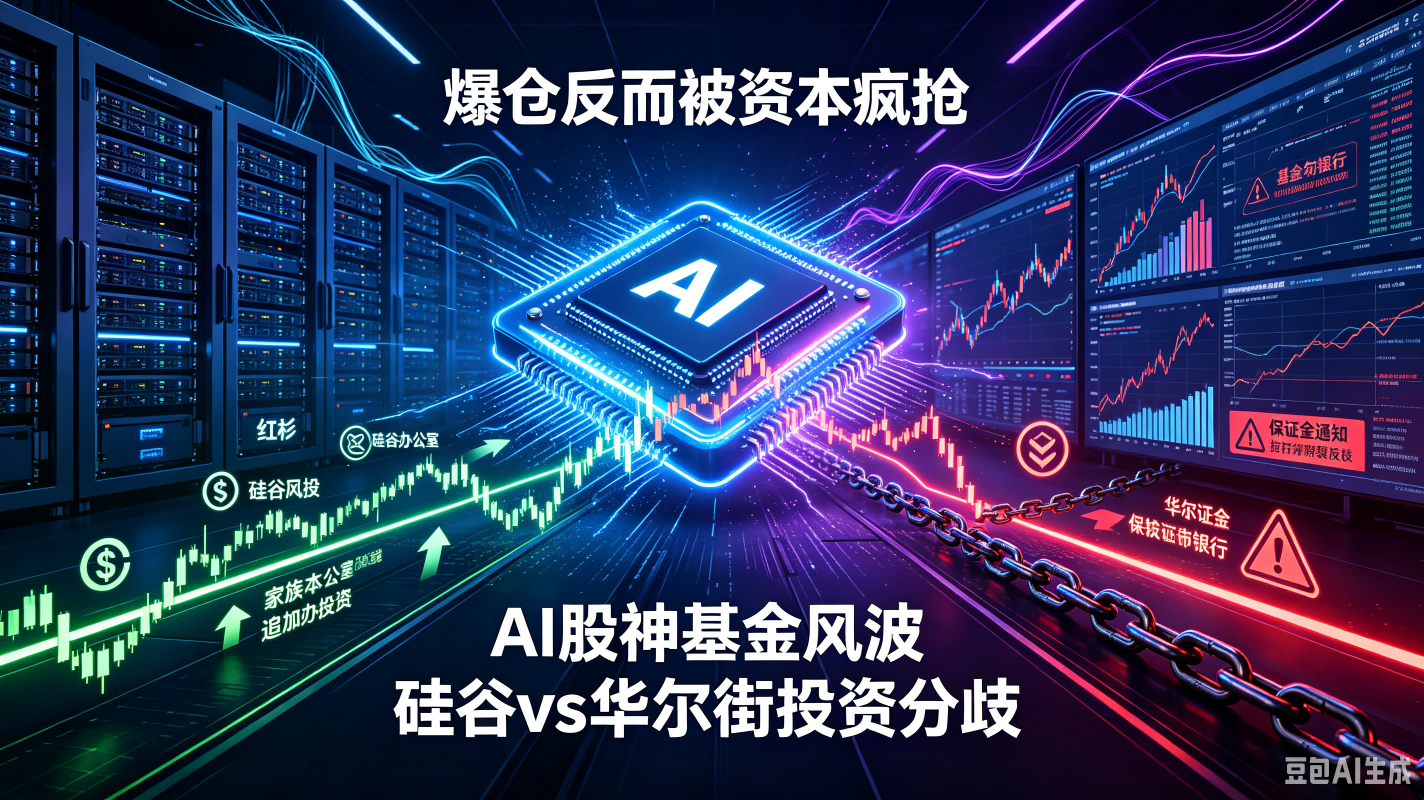
A near-blowup in an AI-focused hedge fund has produced a highly counterintuitive story in the capital markets.
The Situational Awareness fund, led by former OpenAI researcher Leopold, was forced to liquidate major positions at a discount, wiping out a substantial portion of its paper gains.
Yet instead of turning away, a wave of Silicon Valley venture capitalists and family offices reportedly expressed interest in injecting additional capital. Sequoia even publicly backed the founder.
The episode has exposed a fundamental divide between two investment philosophies: Silicon Valley’s willingness to make long-term bets on AI versus Wall Street’s emphasis on disciplined risk-adjusted returns.
It also serves as a warning for AI-focused funds worldwide about the risks of high leverage and concentrated positions.
In July, AI memory and computing stocks suffered a deep, sector-wide sell-off.
Combined with high leverage and concentrated exposure to a single theme, the decline triggered multiple margin calls from Situational Awareness’s banks.
The fund was forced to sell the bulk of its public-equity holdings in a block transaction to Citadel, reportedly at a discount of more than 10%, completing a large-scale emergency liquidation.
After the turmoil, the fund retained roughly $10 billion in assets, including private AI investments that have yet to go public.
The most striking part of the story is that despite the liquidity crisis, the fund was still up approximately 80% for 2026, with returns at one point approaching 440% during the first half of the year.
The founder acknowledged his mistakes in a letter to investors and announced that he would eliminate leverage permanently, describing the liquidation as a “costly but invaluable industry lesson.”
Although the fund has temporarily stopped accepting new capital, interest from Silicon Valley investors has reportedly remained strong. Prominent investor Elad Gil even sought to invest for the first time after the blowup.
The most important takeaway from the episode may be the collision between two fundamentally different capital philosophies.
Sequoia partner Pat Grady publicly backed the founder, stating that Leopold would remain a significant figure in Silicon Valley over the long term.
Many Silicon Valley investors believe Leopold correctly identified the structural shortage in AI computing and memory infrastructure.
From this perspective, the fund’s blowup was primarily a mistake in leverage management rather than a failure of its underlying AI thesis — a form of risk-taking that can be tolerated during a technological transformation.
For some investors, the sell-off has even created an opportunity to increase exposure, particularly given Leopold’s deep understanding of the broader AGI ecosystem.
Banks including Barclays and Morgan Stanley reportedly declined to provide prime-brokerage services to the fund at an early stage, citing concerns over concentrated positions and the founder’s limited experience managing a hedge fund.
Industry veterans have pointed to three major risks:
an overcrowded AI position, leverage exceeding 4×, and relatively illiquid assets.
The combination echoes the underlying mechanics behind historical blowups such as LTCM and Archegos.
Wall Street’s benchmark is ultimately stable, risk-adjusted returns and a controlled drawdown profile. Silicon Valley capital, by contrast, is more willing to prioritize long-term conviction in transformative technologies and tolerate significant short-term volatility.
AI-focused hedge funds have become increasingly polarized in 2026, with extraordinary returns accompanied by equally significant volatility.
Leading AI fund Value Aligned Research reportedly delivered a 194% return year-to-date, significantly outperforming the S&P 500.
The July AI sell-off swept across the sector. Multi-strategy giants including Millennium and Point72 reportedly declined 2%–3% for the month, while concentrated investor Altimeter fell 11%.
Some institutions that anticipated the downturn had already hedged their exposure to AI computing and memory stocks, avoiding much of the liquidity-driven sell-off.
The broader industry lesson is becoming increasingly clear:
AI computing and memory are highly cyclical sectors. Short-term supply and demand can become severely imbalanced, while leverage amplifies both gains and losses.
Once investors begin selling simultaneously, that leverage can create a negative feedback loop of margin calls → forced selling → further price declines → additional margin calls.
After eliminating leverage entirely, Leopold faces a difficult long-term trade-off.
To reproduce the fund’s previous outsized returns, he would eventually need to regain access to leverage from Wall Street banks.
But banks are likely to impose significantly tighter risk controls.
Operating with zero leverage, meanwhile, could substantially lower the fund’s return ceiling.
The episode offers several broader lessons for the AI investment landscape:
AI’s long-term growth story may remain compelling, but investment strategies must balance industry conviction with liquidity risk. Extreme concentration combined with high leverage is difficult to sustain.
The divide between different pools of capital is becoming more pronounced. Silicon Valley venture capital tends to favor long-term bets on foundational technologies, while Wall Street hedge funds are generally more focused on balanced exposure and risk-adjusted performance. That divergence could continue to shape how AI assets are valued globally.
Strong sector momentum does not eliminate investment risk. The cyclical nature of AI computing and memory, combined with leverage and liquidity risks, remains a structural issue for anyone investing in the AI theme.
The unusual case of an AI fund attracting more attention after a near-blowup offers a broader warning for investors — including those betting on AI computing and semiconductor markets in China.
A booming AI sector does not mean a risk-free trade.
When cyclical supply shocks meet concentrated positions and leverage, even the strongest investment thesis can be overwhelmed by liquidity risk.

AI Market Research & Consumer Insights Provider
China's Leading Treasury Management Software Provider
AI落地解决方案及数字化创新服务提供商
A high-tech enterprise integrating product design, R&D, sales, and services.
Leading full-scenario data intelligence service provider in China.