On July 30, the European Union officially launched a new round of calls for AI gigafactories, with plans to build seven massive computing facilities designed to train next-generation AI models. The EU and its member states will provide around €10 billion in public funding, aiming to attract roughly €20 billion in private investment. The first facilities are expected to become operational in 2028.
This is Europe’s largest coordinated push to build AI infrastructure to date.
But when a region needs public funding to catch up in a race that its competitors have already been running for years, the problem is no longer simply about computing power.
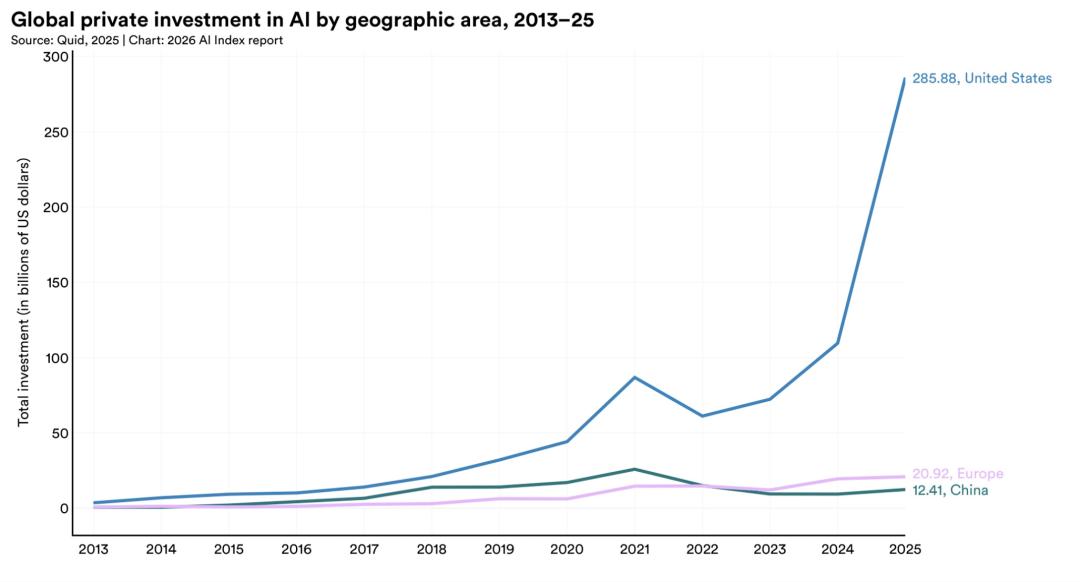
Stanford University’s 2026 AI Index Report offers a number that is difficult to ignore: in 2025, private AI investment in the United States reached approximately $285.9 billion, compared with $5.9 billion in the UK, $4.4 billion in France, and $3.9 billion in Germany.
Narrow the scope to generative AI, and the gap becomes even more striking. U.S. private investment in generative AI reached roughly $163.6 billion that year, while Europe attracted just $3.2 billion — a difference of exactly 50×.
In 2025, around 60% of the world’s leading AI models came from the United States, 30% from China, and less than 5% from Europe. Among the landmark AI models released globally in 2024, the U.S. led with 40, followed by China with 15. The EU produced just three, all from France.
The €30 billion AI gigafactory plan may sound massive, but in the global context, its scale is relatively modest.
OpenAI alone raised $40 billion in March 2025, more than the combined private AI investment in France and Germany that year.
More importantly, Europe’s financial system remains heavily bank-oriented. That works relatively well for companies with stable cash flows and physical assets that can be used as collateral, but it is far less suited to funding model companies that may operate at a loss for years while their core assets consist primarily of talent and algorithms.
The European Investment Bank describes this as a scale-up financing gap: when companies grow from hundreds to thousands of employees and move from a single product to global markets, they often lack access to sufficiently large pools of growth capital.
U.S. model companies also benefit from another unique layer of support.
Since 2023, Amazon, Google, Meta, and Microsoft have collectively invested around $1.1 trillion in AI infrastructure, with another $745 billion expected to be added this year alone.
A European AI company has to raise its own capital, buy its own compute, and build its own products. Its competitors, meanwhile, can tap into the infrastructure, capital, and distribution networks of some of the world’s largest technology companies.
If OpenAI had grown up in Europe, its first major obstacle might not have been model capability at all.
It might have been finding long-term, large-scale capital that is willing to tolerate failure.
Europe has ASML and Arm, but neither of these strategic assets can directly translate into scalable, readily accessible computing capacity.
ASML sits upstream in the semiconductor supply chain, while Arm has built one of the world’s largest chip-architecture ecosystems. But Europe lacks the ability to connect these individual strengths into a complete computing stack.
In AI chips, Europe has no AI-compute supplier on the scale of Nvidia.
In advanced manufacturing, it lacks a cutting-edge foundry comparable to TSMC.
And in cloud computing, none of the world’s major hyperscalers is European.
A complete AI compute stack requires, at minimum, chip design, advanced manufacturing, servers, data centers, energy, cloud services, and model training.
The U.S. advantage lies in having domestic industries that reinforce one another and form a relatively integrated system.
Europe’s capabilities, by contrast, are distributed across different countries, companies, and markets.
Energy is another hard constraint.
European electricity prices are generally two to three times higher than those in the U.S. and China. AI factories and data centers are enormous consumers of electricity and cooling resources, making power availability an increasingly important variable in the expansion of Europe’s AI infrastructure.
Perhaps most symbolically, a European Commission spokesperson has openly acknowledged the reality: Europe does not currently produce the cutting-edge chips required to develop these supercomputing facilities.
The U.S. has Microsoft, Google, Amazon, and Meta.
China has Alibaba, Tencent, ByteDance, and Baidu.
These technology giants have cloud computing, search, advertising, productivity software, e-commerce, social media, and content platforms at their disposal. They can use existing cash flows to fund AI models and then embed those models directly into products that already have millions or billions of users.
Europe’s globally influential companies, by contrast, are concentrated more heavily in industrial software, automation, energy, automotive, healthcare, and enterprise management.
SAP, Siemens, Bosch, Schneider Electric, and Dassault Systèmes control critical parts of enterprise workflows and industrial data. But they do not have the kind of mass-market consumer platforms that tens or hundreds of millions of people open every day.
Europe’s BAT is largely growing inside the factory.
By 2026, around 48% of European manufacturing companies were reportedly using AI at scale, compared with 28% in the U.S.
Siemens, for example, is embedding AI into digital twins, hardware, and software to make factories and production processes increasingly intelligent.
Europe’s AI advantage lies in industry, not consumer internet.
It may not need another OpenAI.
What it needs could be AI that understands factories, industrial software, and production workflows.
Europe has world-class universities and engineers.
DeepMind was born in London, while many major U.S. AI companies have established research centers across Europe.
But Europe trains much of the talent, while U.S. companies attract it with higher compensation, greater access to compute, equity incentives, and a more mature startup exit ecosystem.
Even when researchers remain in Europe, companies can turn to U.S. capital, chips, and cloud platforms once they enter the scale-up phase.
The European Central Bank has noted that between 2008 and 2021, nearly 30% of European-founded unicorns later relocated abroad, with the vast majority moving to the United States.
Europe bears much of the cost of education and basic research.
The U.S. ecosystem captures much of the value generated at scale.
Mistral AI is perhaps Europe’s closest attempt at building an OpenAI-scale model company.
It has no shortage of technical ambition or industry attention.
In the first quarter of 2026, Mistral secured an $830 million syndicated loan from seven banks, with roughly three-quarters of the financing reportedly earmarked for Nvidia chip procurement.
Yet even this record-setting European financing remains on a completely different scale from its U.S. competitors.
Anthropic recently raised $13 billion, while OpenAI’s latest financing reached $40 billion.
More importantly, Mistral is being asked to play several roles at once: model developer, cloud infrastructure builder, enterprise software provider, and symbol of European technological sovereignty.
Behind OpenAI, many of these responsibilities are shared with Microsoft and the broader U.S. capital markets.
Under Europe’s current startup environment, that is an extraordinarily difficult burden for a single company to carry.
Seven AI gigafactories can help close the compute gap.
But that is only the first step.
Until capital, chips, cloud infrastructure, markets, and the economic rewards of talent are able to remain within the same industrial ecosystem, Europe can have Mistral, ASML, and Siemens — and still struggle to produce its own OpenAI.

AI Market Research & Consumer Insights Provider
China's Leading Treasury Management Software Provider
AI落地解决方案及数字化创新服务提供商
A high-tech enterprise integrating product design, R&D, sales, and services.
Leading full-scenario data intelligence service provider in China.