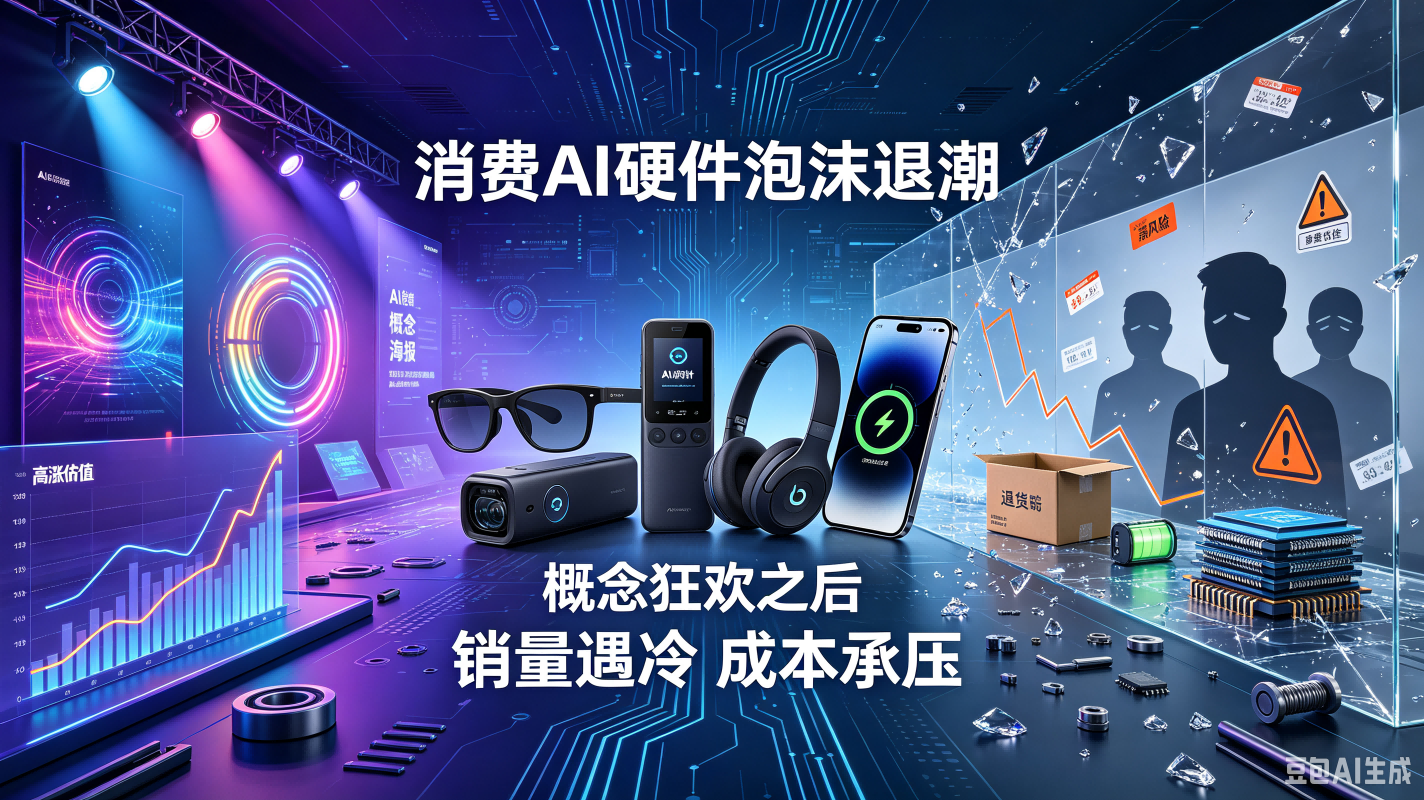
As the excitement around foundation models sweeps across the world, the consumer AI hardware market — once one of the most heavily backed areas of the AI boom — is facing a brutal market shakeout.
A growing number of AI-branded hardware products have gone from launch-day hype to disappointing sales, shelved projects, and even company closures.
The industry is beginning to confront a simple reality:
An AI label does not automatically create a compelling product, and flashy concepts do not necessarily translate into value that consumers are willing to pay for.
As the hype fades, the market is moving away from storytelling and back toward something more fundamental: real user needs and sustainable unit economics.
Over the past two years, consumer AI hardware seemed unstoppable.
From AI pins and wearable assistants to AI glasses and dedicated personal devices, startups attracted massive funding, valuations soared, and expectations grew that AI hardware could replicate the smartphone revolution and become the next major personal computing interface.
High-profile projects emerged one after another. Backed by impressive demos and celebrity founders, some companies raised hundreds of millions of dollars before their products had even reached meaningful scale.
The idea of “AI replacing the smartphone” captured the imagination of the market.
Reality proved much harder.
Poor battery life, limited computing power, fragmented user experiences, and high prices became recurring problems across the first generation of AI hardware.
Products that looked impressive in launch presentations often struggled in everyday use. Recognition errors, latency, bugs, and limited core functionality made it difficult for consumers to justify premium prices.
The result was an awkward gap between launch-day excitement and actual adoption.
Some products generated enormous attention before quickly fading from the market.
A clear divide is emerging across the value chain.
Upstream suppliers of computing power, chips, memory, and other components continue to benefit from the AI boom, with strong demand supporting revenue and profits.
Downstream consumer hardware companies face a very different equation.
On one side, the cost of HBM, memory, processors, and other critical components continues to put pressure on bill-of-materials costs.
On the other, consumers remain reluctant to pay significantly more for immature AI experiences.
The result is a squeeze from both directions:
higher costs + limited pricing power = shrinking margins.
For many companies, a sustainable business model remains difficult to establish.
Capital markets are adjusting accordingly.
The era of funding a company simply because the story sounded compelling is giving way to a much harder set of questions: Where is the revenue? What are the margins? How much cash is being burned?
Projects without meaningful evidence of product-market fit are finding it increasingly difficult to raise capital.
Industry research also points toward consolidation. The number of AI chip and hardware startups is expected to contract, with analysts anticipating significant M&A activity and company exits over the next one to two years.
The same dynamic is particularly visible in robotics and AI hardware: even if the long-term market opportunity is enormous, a relatively small number of companies may ultimately capture most of the value.
The cooling market does not mean consumer AI hardware is finished.
It means the industry is becoming more selective about what actually qualifies as valuable AI hardware.
The market is moving away from “AI for AI's sake” and toward products that solve a problem people genuinely care about.
Big tech companies are adjusting too.
Reports suggest OpenAI's first hardware project may be moving toward a more basic form factor as cost pressures reshape the original vision of a high-compute standalone device.
Rather than attempting to deliver a science-fiction-level product from day one, the priority may increasingly be affordability, reliability, and a genuinely useful experience.
Chinese manufacturers are also becoming more pragmatic.
Instead of betting everything on entirely new hardware categories, more companies are integrating AI capabilities into established devices such as smartphones and earbuds — focusing on on-device models and incremental improvements rather than trying to reinvent personal computing overnight.
For entrepreneurs, the rules of the game are changing:
❶ Solve a real problem before selling an AI story.
Find a user pain point that exists independently of the technology.
❷ Respect the economics of the supply chain.
Performance, power consumption, component costs, and retail price cannot be optimized independently.
❸ Start with a focused use case.
Forget the grand promise of “replacing the smartphone.” Start with a specific problem, prove that users care, and build the business model from there.
Consumer AI hardware is going through a necessary reality check.
A retreat in capital does not necessarily mean the industry is dying. It can also be a process of separating genuine product value from speculation.
Companies built primarily on concepts, demos, and PowerPoint presentations may struggle to survive.
Those that can balance technology, cost, usability, and genuine consumer demand will be better positioned for the next phase of the market.
The AI hardware revolution may still happen.
It may simply arrive later, move more slowly, and prove far harder to build than the hype originally suggested.

AI Market Research & Consumer Insights Provider
China's Leading Treasury Management Software Provider
AI落地解决方案及数字化创新服务提供商
A high-tech enterprise integrating product design, R&D, sales, and services.
Leading full-scenario data intelligence service provider in China.