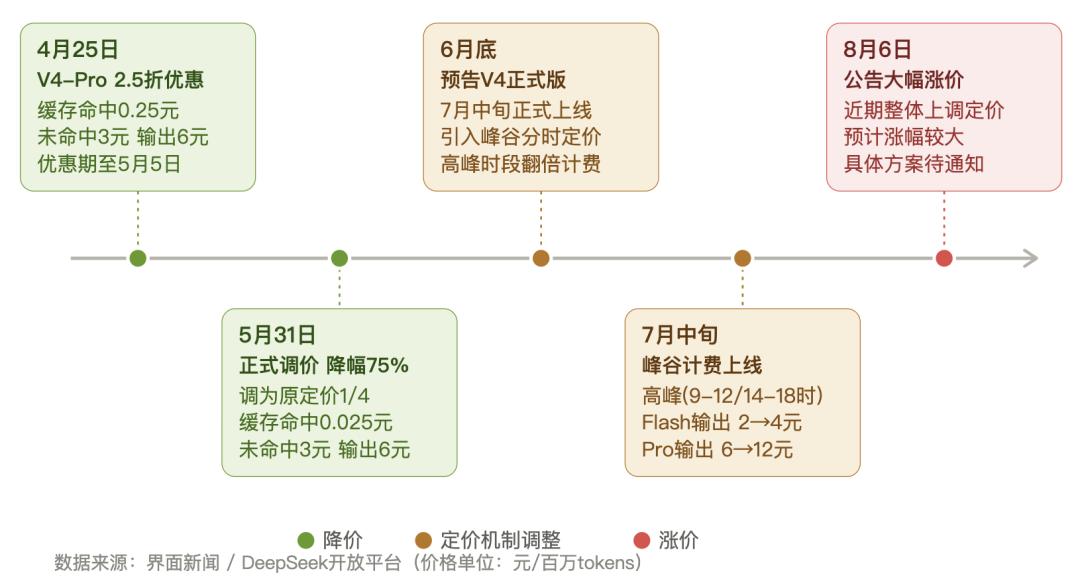
On August 6, a brief announcement from DeepSeek sent ripples through the developer community: the platform plans to raise its overall API pricing in the near future, with a potentially significant increase.
The announcement came just three weeks after DeepSeek introduced peak-hour pricing that effectively doubled rates in mid-July. The company that once single-handedly drove large-model API prices down to rock-bottom levels is now sending a clear signal that its ultra-low-price strategy may have reached an inflection point.
Looking back at DeepSeek’s API pricing history, the company first pushed prices down to industry-floor levels in April 2024, charging just RMB 1 per million input tokens and RMB 2 per million output tokens.
It continued to cut prices several times afterward, including a more than 50% reduction in September last year. At the time, the market interpreted the move as a strategic decision to sacrifice short-term profitability in exchange for market share.
The turning point came in May this year.
DeepSeek announced that its temporary 2.5×-discounted pricing for V4-Pro would become permanent, bringing the price down to RMB 3 per million input tokens and RMB 6 per million output tokens.
Just one month later, in late June, DeepSeek announced that the official V4 release would introduce peak/off-peak pricing, with rates doubling during weekday peak hours.
At the time, the market could still interpret the move as a more sophisticated approach to capacity management rather than a straightforward price increase.
But the August 6 announcement changed that expectation entirely.
This time, it is the overall pricing baseline that is moving upward.
According to pricing information published on DeepSeek’s developer platform, its two major models currently operate under a multi-tier pricing structure.
For V4-Flash, cached input costs just RMB 0.02 per million tokens, while uncached input costs RMB 1 and output costs RMB 2 per million tokens.
For V4-Pro, cached input costs RMB 0.025 per million tokens, uncached input costs RMB 3, and output costs RMB 6 per million tokens.
Just how low is that?
At an exchange rate of roughly RMB 7.2 to US$1, GPT-5.5’s output pricing works out to around RMB 216 per million tokens — more than 30 times the output price of DeepSeek V4-Pro.
For output alone, DeepSeek charges just RMB 2 per million tokens, while Anthropic’s Claude Opus 4.8 costs roughly RMB 170 per million tokens for a comparable task.
That extreme price advantage is precisely why DeepSeek earned its reputation among developers worldwide as a “price slayer.”
The most immediate pressure is coming from the demand side.
On July 31, the official version of DeepSeek-V4-Flash was released with significantly enhanced agent capabilities. According to data disclosed by the OpenCode platform, V4-Flash processed a staggering 8 trillion tokens on the platform on August 1 alone.
The latest weekly data from multi-model aggregation platform OpenRouter showed DeepSeek V4 Flash ranking first globally, with 7.22 trillion tokens in weekly usage.
On August 4, the platform even experienced capacity constraints amid unprecedented traffic.
Some developers joked that the servers had finally been “squeezed to the limit.”
The explosive growth in demand has translated directly into sharply rising compute costs.
Pan Helin, a member of the Information and Communications Economics Expert Committee under China’s Ministry of Industry and Information Technology, said the price increase was primarily driven by rising costs.
As agent-based applications become more widespread, individual tasks consume significantly more tokens than traditional chatbot interactions. DeepSeek’s compute bill is therefore expanding faster than expected.
At the same time, the entire AI industry is shifting away from a pure “slash prices to acquire users” strategy toward commercialization under economically sustainable cost structures.
Over the past two years, foundation-model companies aggressively cut API prices and offered large amounts of free usage.
But entering the second half of 2026, rising demand for compute, higher chip procurement costs, and growing operating expenses are making the pure low-price-for-scale model increasingly difficult to sustain.
DeepSeek is far from the only Chinese AI company raising prices.
Zhipu’s API pricing in the first quarter of 2026 was reportedly around 83% higher than at the end of 2025, while its API call volume still increased by 400%, pointing to simultaneous growth in both pricing and demand.
Moonshot AI also significantly raised API prices in July alongside the launch of Kimi K3, with input priced at RMB 20 per million tokens and output at RMB 100 per million tokens — more than triple the previous input price and nearly four times the previous output price.
Doubao Professional introduced a three-tier subscription structure, while Alibaba Cloud, Tencent Cloud, and Baidu AI Cloud had already collectively raised prices for AI-compute-related services earlier this year.
DeepSeek has yet to disclose the exact size or effective date of its upcoming price increase.
But the wording — “a significant increase” — suggests that this could represent more than a routine adjustment. It may mark a structural repricing of DeepSeek’s API economics.
For small developers and AI startups that rely heavily on DeepSeek’s API, higher prices could mean their monthly inference costs rising by several times.
Some companies previously migrated their entire stacks to DeepSeek precisely because of its extraordinary cost-performance ratio.
Now, they may have to run the numbers all over again.
As one developer put it on social media:
“Is Liang still the same ‘Liang Saint’? We’ll see how big the increase is.”

AI Market Research & Consumer Insights Provider
China's Leading Treasury Management Software Provider
AI落地解决方案及数字化创新服务提供商
A high-tech enterprise integrating product design, R&D, sales, and services.
Leading full-scenario data intelligence service provider in China.