On April 14, 2026, the main forum of the 12th CDIE (China Digital Innovation Expo) & GDIE (Global Digital Innovation Expo) China Station officially opened at the Shanghai Zhangjiang Science Hall.
As a high-impact summit bringing together technology and business, CDIE 2026 centered on the theme “Turning AI into Productivity.” The event aimed to create an international platform focused on the deep integration of AI into business practices, with a particular emphasis on real-world implementation and validation.
The conference brought together 4,000+ business executives, 150+ speakers from China and around the world, and 120+ exhibitors, spanning 10 major industries and dedicated forums, including manufacturing, retail, FMCG, healthcare, finance, humanoid robotics, and more. Through cross-industry dialogue and hands-on scenario experiences, participants explored the barriers to AI adoption and examined what the next era of intelligent business could look like.

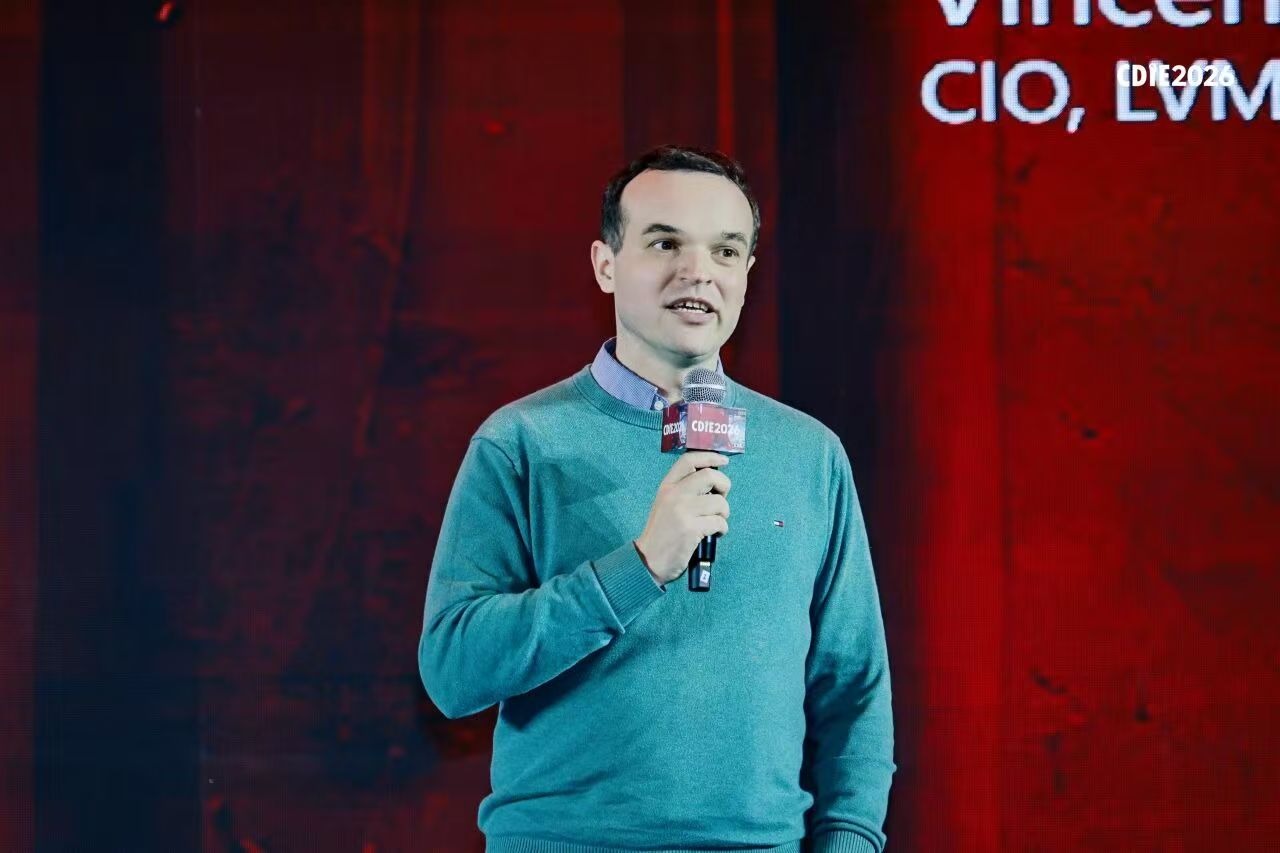
One of the highlights of the main forum was a keynote delivered by Vincent Delacourt, Chief Information Officer, LVMH Fashion Group Greater China, titled:
“Your Job Has Never Been About Collecting Information — AI Adoption Starts with People, Not Technology.”
With nearly 20 years of experience living and working in China, the technology leader brought a distinctive perspective shaped by both European and Asian markets. He offered a critical reflection on the challenges enterprises are facing in implementing AI today, while sharing LVMH’s distinctive approach to digital transformation — one that places people at the center of the process.
At the beginning of his presentation, Vincent Delacourt identified three fundamental reasons why enterprise AI initiatives often fail:
AI tools are disconnected from users’ actual day-to-day work. Without understanding the context of the company, team, or individual role, AI tends to produce overly generic answers that deliver little practical value.
AI systems that lack learning, memory, and adaptation capabilities quickly become irrelevant. If users try a tool on day one and receive mediocre results, they may simply never come back.
Employees may use AI secretly, viewing it as a form of “cheating” and worrying that their work or value will be questioned if their use of AI is discovered. As a result, AI adoption becomes limited to safe and invisible tasks such as translation.
This culture of fear can undermine AI adoption before implementation even begins.
In response to these challenges, Vincent put forward a powerful idea:
“Your job has never been about collecting information.”
He argued that the core value of human work needs to be redefined in the age of AI.
Much of what people traditionally spend time doing — collecting data from multiple sources, copying it into templates, adjusting fonts and charts, and reformatting spreadsheets — is essentially low-value “assembly work.” This is precisely the kind of work AI should absorb.
Human value, by contrast, lies in judgment:
Deciding what matters
Organizing information so others can take action
Identifying insights that others may have overlooked
Ultimately taking responsibility for decisions
Vincent illustrated this shift with a simple example:
“A report used to take two days. Now it takes two hours: 90 minutes of thinking and 30 minutes of production. AI produces. You think.”
To make AI genuinely useful to people, Vincent Delacourt shared the “Golden Rules” drawn from LVMH’s experience, covering both the user and system sides.
1. Better or Faster
AI should help users perform tasks they already do — either better or faster.
2. Augmented, Not Replaced
Users should feel empowered rather than replaced. Their responsibility remains intact.
3. I Am Better Because of It
Users must feel that they perform better with AI than without it.
4. I Am Still in Control
The user remains in the driver’s seat when it comes to decision-making.
1. Have Context
AI must understand the company, team, and role. Without context, AI is simply a “stupid parrot.”
2. Learn Automatically
The more it is used, the smarter it should become. Every interaction should contribute to its evolution.
3. Stay Transparent
Users need to understand what data was used and why a particular decision was made. If people do not understand, they will not trust it; without trust, they will not use it.
4. Guide, Don’t Force
AI should support the way people work rather than forcing them into rigid new processes.
5. Design vs. Compliance
Humans should be responsible for designing workflows, while AI ensures that processes are executed in compliance.
Vincent systematically outlined three key pillars through which AI creates value for LVMH:
AI absorbs purely administrative “assembly work,” such as pulling data from multiple systems, copying and pasting information, and reformatting content.
By allowing AI to handle repetitive and time-consuming tasks, people can focus their energy on higher-value decision-making.
AI transforms data into actionable insights, making decision-making more transparent and efficient.
Vincent also shared LVMH’s distinctive bottom-up four-layer adoption strategy, moving from individuals to teams, processes, and ultimately the organization.
The goal is for employees to first experience AI as a tool designed around their needs, helping establish trust and confidence in its use.
At the cultural level, Vincent advocated a shift in mindset:
“More productivity means producing more, not producing less.”
Organizations should adopt the “right mindset” — retaining talent while enabling people to deliver greater and fundamentally different outcomes.
With nearly two decades of experience in China, Vincent also introduced the AI technology stack LVMH has built in the Chinese market.
ATOM China, a unified customer data platform built on Alibaba Cloud Dataphin, integrates signals from more than 30 brands to enable personalized experiences and service orchestration.
LVMH leverages Alibaba Cloud PAI for customer segmentation and recommendations, while using Qwen and the Bailian platform to develop generative AI applications adapted to the preferences of Chinese consumers.
Through features such as 3D product visualization, virtual try-on, and livestreaming on Tmall Luxury, LVMH connects digital customer touchpoints seamlessly with offline boutiques.
This architecture reflects LVMH’s approach to localized innovation within a global framework:
“In China, for China, for the world.”
In his closing remarks, Vincent Delacourt summarized LVMH’s AI model as a balance between augmentation and preservation.
Scale personalized customer service
Generate and localize content
Forecast demand and optimize supply chains
Improve internal productivity
Optimize omnichannel e-commerce
Brand curation and creative direction
Client advisor relationships
Luxury service experiences
Strategic judgment and taste
“AI in the background. Personalization in the foreground. Human service at the center.”
These three principles form the core model of LVMH’s digital transformation.
Vincent left the audience with a clear message: the key to successful AI adoption is not simply accumulating more technology. It lies in changing how people think, strengthening organizational capabilities, and transforming management systems.
Vincent Delacourt’s keynote, with its depth of insight, clear logic, and practical examples, offered valuable guidance for enterprises navigating the deeper stages of AI transformation.
His presentation demonstrated that across industries — even in luxury, where the pursuit of exceptional customer experiences is paramount — the ultimate destination of digital transformation is people.
Only by putting people first and making technology serve people can organizations make the critical leap from technological excitement to tangible productivity.

AI Market Research & Consumer Insights Provider
China's Leading Treasury Management Software Provider
AI落地解决方案及数字化创新服务提供商
A high-tech enterprise integrating product design, R&D, sales, and services.
Leading full-scenario data intelligence service provider in China.