The next phase of artificial intelligence may not be defined by larger language models alone. Instead, it could be shaped by something more fundamental: the infrastructure required to power AI agents at scale.
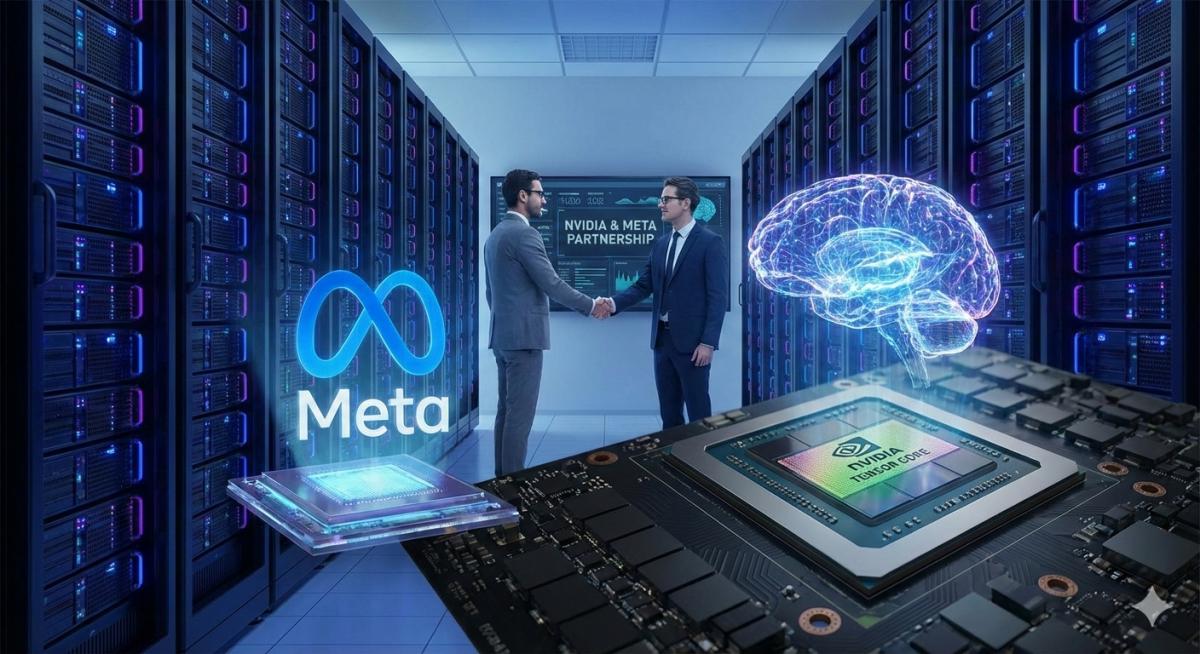
On October 26, 2026, NVIDIA and Meta announced an expanded strategic collaboration covering Meta's Muse family of AI models, next-generation computing infrastructure and technologies designed to support AI agent development and deployment.
Under the agreement, the two companies will work together to optimize the training and inference performance of Muse models and explore additional technologies for improving agent security and monitoring. Meta also plans to expand its deployment of NVIDIA's Vera Rubin platform, Vera CPUs, Spectrum-X networking and BlueField-4 infrastructure.
The announcement also includes a proposed $3 billion investment by NVIDIA in Meta's equity offering.
More than another partnership between two technology giants, this development highlights a broader industry shift: as AI moves from generating content to completing tasks, the infrastructure supporting it must evolve accordingly.
For much of the recent AI boom, industry attention has focused on large language models, generative capabilities and the race to build increasingly powerful foundation models.
However, the next stage of AI adoption is moving beyond simple question-and-answer interactions.
AI agents are designed to understand objectives, reason through multiple steps, interact with software tools, retrieve information and execute tasks with varying degrees of autonomy.
Rather than generating a single response, an agent may need to perform a sequence of operations: analyse a request, retrieve relevant data, write and execute code, interact with external applications and evaluate the results.
This creates a different computing workload.
Traditional AI inference typically involves processing a user request and generating an output. Agentic workflows can involve repeated model calls, tool execution, data retrieval and continuous reasoning.
As a result, the infrastructure requirements become more complex.
Companies need more than powerful GPUs. They also need efficient CPUs, high-performance networking, fast data access, reliable storage and systems capable of coordinating multiple AI operations.
This is one of the reasons why the NVIDIA–Meta collaboration is significant.
It reflects the growing importance of infrastructure designed not only to train AI models, but also to support the continuous execution of intelligent agents.
NVIDIA has traditionally been recognised for its leadership in GPU computing and AI accelerators. However, its strategy increasingly centres on delivering a comprehensive computing platform.
The expanded collaboration with Meta illustrates this approach.
Muse and the evolution of AI models
Meta's Muse family represents part of the company's broader effort to develop advanced AI models and agent-based experiences.
Through the expanded collaboration, NVIDIA and Meta intend to optimise model training and inference workflows, with the aim of improving performance and total cost of ownership.
For AI companies, this is particularly important as models become more capable and are deployed across increasingly large user bases.
The challenge is no longer simply developing a powerful model. It is making that model efficient, reliable and economically viable at scale.
Vera Rubin and next-generation computing infrastructure
Meta also plans to expand its deployment of NVIDIA's Vera Rubin platform and Vera CPUs.
The Vera Rubin platform is designed to support demanding AI workloads, including model training and inference. Vera CPUs can support the compute-intensive tasks surrounding agent execution, such as running tools, processing code and retrieving data.
The collaboration also involves NVIDIA Spectrum-X networking and BlueField-4 technologies, which are intended to support high-throughput data movement and infrastructure operations.
Taken together, these technologies demonstrate how AI infrastructure is becoming increasingly integrated.
The future of AI computing will depend on the interaction between processors, networking, software and data systems rather than the performance of any single component.
One of the most important implications of this partnership is the growing commercial significance of agentic AI.
AI agents are increasingly being explored across a wide range of applications:
· Enterprise productivity: Automating research, reporting, document processing and internal workflows.
· Software development: Assisting with coding, testing, debugging and software maintenance.
· Customer experience: Supporting customer service operations and personalised digital interactions.
· Data intelligence: Collecting, analysing and interpreting information from multiple business systems.
· Business operations: Coordinating repetitive tasks across enterprise applications and departments.
However, deploying agents at scale introduces new operational challenges.
An enterprise may have dozens of agents interacting with different databases, applications and internal systems. Each interaction requires computing resources, data access and appropriate security controls.
This means that the growth of agentic AI could create demand across several layers of the technology stack.
First, more sophisticated models require substantial computing capacity. Second, agents need reliable access to enterprise data and software tools. Third, businesses need infrastructure capable of monitoring agent activities and enforcing security policies.
The infrastructure opportunity therefore extends beyond AI chips into networking, cloud computing, data management and enterprise software.
As AI agents become more autonomous, security becomes a central consideration.
An AI model that generates text presents a different risk profile from an agent that can access company databases, execute code or interact with external systems.
An agent operating within an enterprise environment may encounter sensitive information, execute actions with business consequences or interact with systems that were not originally designed for autonomous AI access.
This makes visibility and control essential.
NVIDIA and Meta have indicated that their expanded collaboration may also explore NVIDIA's OpenShell Reference Architecture and NVIDIA Sentry technologies.
These initiatives focus on areas such as safer agent deployment and monitoring agent behaviour.
For enterprises, this reflects a wider shift in AI governance.
Traditional cybersecurity frameworks were largely designed around human users, applications and defined system permissions. Autonomous agents introduce a more dynamic operating environment.
Organisations will increasingly need to establish:
· Clear identity and access controls for AI agents.
· Restrictions on which systems and data agents can access.
· Monitoring and auditing of agent activities.
· Human approval for sensitive or high-impact operations.
· Mechanisms to detect and respond to unexpected behaviour.
The ability to deploy AI agents safely may become just as important as the ability to develop more capable models.
The NVIDIA–Meta partnership offers several lessons for businesses planning their AI strategies.
AI infrastructure needs to be designed around business workloads.
Companies should evaluate computing requirements based on actual use cases, including model training, inference, agent execution and data processing.
The most powerful infrastructure is not necessarily the most cost-effective solution for every enterprise.
AI adoption requires an integrated technology ecosystem.
Successful AI deployment depends on more than access to a foundation model. Businesses must consider how models connect with enterprise data, existing applications, cloud platforms and operational workflows.
Security must be incorporated from the beginning.
As agents gain access to more business systems, governance cannot be treated as an afterthought. Security architecture, access permissions and monitoring mechanisms should be part of the initial deployment strategy.
The business case must extend beyond experimentation.
Enterprises should evaluate AI based on measurable outcomes, such as reduced processing time, improved service quality, operational efficiency and better decision-making.
Ultimately, the value of agentic AI will depend on whether organisations can translate technical capabilities into sustainable business results.
The expanded NVIDIA–Meta partnership highlights a significant transition in the AI industry.
The first phase of the generative AI boom was largely defined by the development of increasingly powerful models.
The next phase may be defined by the infrastructure, platforms and governance systems required to deploy those models as intelligent agents across everyday business operations.
This shift creates opportunities for semiconductor companies, cloud providers, networking specialists, software developers and enterprise technology vendors.
It also raises a more important question for business leaders: are their organisations prepared for a future in which AI does not simply assist employees, but actively participates in executing business processes?
For NVIDIA and Meta, the expanded collaboration represents a strategic investment in that future.
For enterprises, it is another reminder that the next stage of digital transformation will require more than adopting AI tools. It will require rethinking the infrastructure, workflows and governance models that allow intelligent systems to operate at scale.
At Dot Connector, we believe the next competitive advantage in AI will come from connecting intelligent models with the infrastructure, data and business processes that turn AI capabilities into real-world value.
The agentic AI era is taking shape. The organisations that prepare for it today will be better positioned to participate in the next wave of digital transformation.
About Dot Connector
Dot Connector is a global digital innovation platform connecting businesses, technology leaders and innovation ecosystems. Through industry insights, international events and cross-sector collaboration, Dot Connector explores how emerging technologies are transforming businesses and creating new opportunities for growth.
Source: NVIDIA official announcement, October 26, 2026. Forward-looking statements regarding product deployment and future collaboration reflect company announcements and plans.

AI Market Research & Consumer Insights Provider
China's Leading Treasury Management Software Provider
AI落地解决方案及数字化创新服务提供商
A high-tech enterprise integrating product design, R&D, sales, and services.
Leading full-scenario data intelligence service provider in China.