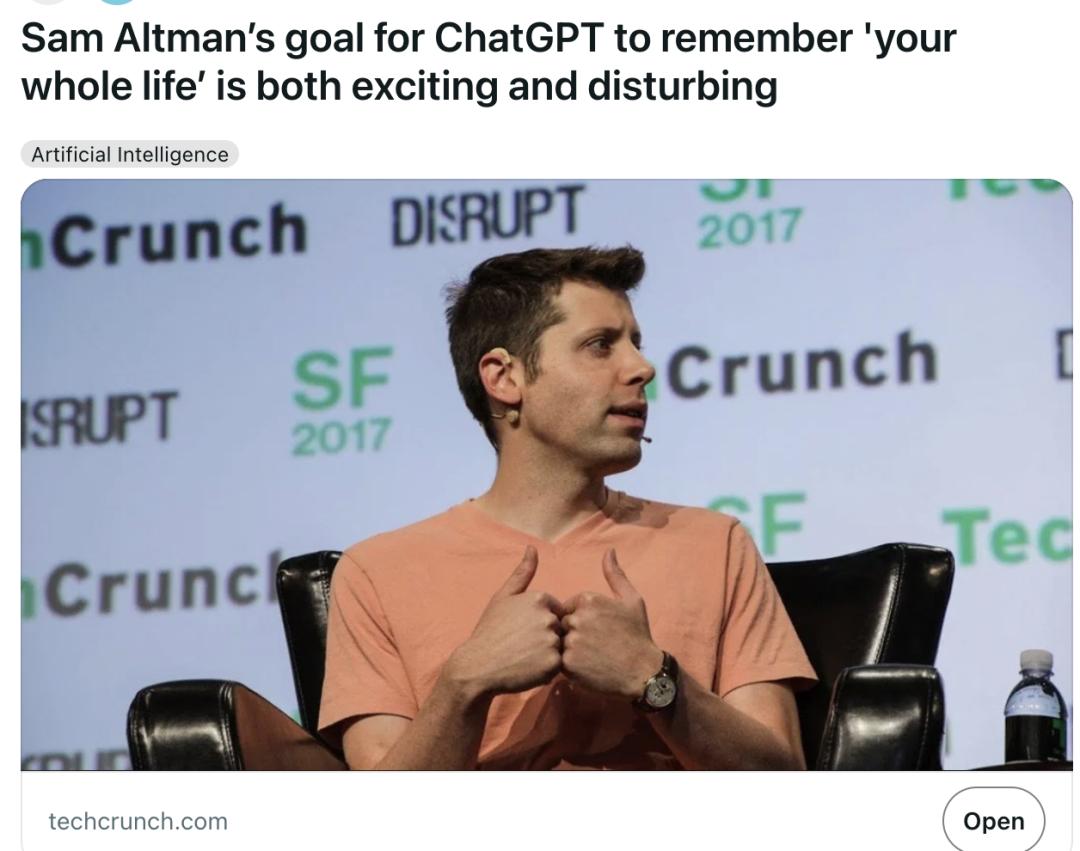
In a recent conversation with Silicon Valley interns, Sam Altman said we may be just one model generation away from an AI assistant becoming truly, extraordinarily useful.
He wasn’t talking about better memory or a larger context window. He was talking about continuously seeing your screen, recording every meeting, and understanding the full context of your life.
That would represent a fundamental shift in the human-AI relationship — from conversation to coexistence.
For the past two years, Altman has repeatedly described a similar vision: a tiny reasoning model with a trillion-token context window, capable of remembering everything about your life and continuously adding to that knowledge.
He has also drawn a clear distinction between generations of users: older people tend to use ChatGPT as a replacement for Google; people in their 20s and 30s increasingly treat it as a life advisor; and college students are already using it almost like an operating system.
Now, Altman is explicitly pointing to screen awareness and comprehensive meeting recording.
The next generation of AI, he suggests, could understand your world in a fundamentally deeper way within just six months.
The early blueprint for this transformation is already emerging.
On April 21, OpenAI introduced Chronicle as a research preview within Codex. The feature uses intermittent background screenshots and OCR to generate memories about what you have recently been working on, saving them as local Markdown files.
After trying it himself, OpenAI President Greg Brockman described the experience as “surprisingly magical.” Its internal codename was reportedly Telepathy — a name Altman has said is fitting.
Screenshots are uploaded to OpenAI’s servers for OCR and visual analysis. After generating a summary, the information is sent back to the local device. The original screenshots are deleted after six hours, while the Markdown summaries are retained permanently.
In June, ChatGPT introduced its Dreaming V3 memory system. It automatically synthesizes memories from conversation history and incorporates a sense of time.
For example, if you once said you were going to Singapore in July, the system can update that memory after July has passed to reflect that you actually went to Singapore.
In OpenAI’s internal evaluations, factual recall improved from 67.9% to 82.8%, preference following from 55.3% to 71.3%, and time-sensitive accuracy from 52.2% to 75.1%. Computational efficiency also improved by roughly 5×, making the system available to free users.
Chronicle focuses on screen-level context. Dreaming V3 focuses on synthesizing conversational context.
Together, they are moving toward the always-on, deeply personalized AI assistant that Altman has been describing.
And the entire industry is betting on the same direction.
Google is taking an enterprise-focused approach. Memory Bank has been introduced to Gemini’s enterprise agent platform, allowing developers to give AI agents a persistent pool of memory that carries across sessions.
Anthropic also expanded persistent memory to all Claude users in March, including both free and paid users. In April, it added a public beta of persistent memory to its developer-facing Managed Agents.
Third-party platforms are entering the race as well. Projects such as Mem0 are positioning themselves as cross-platform memory infrastructure, connecting OpenAI, Anthropic, and open-source models.
That points to a problem the industry is increasingly aware of: if every AI giant builds its own isolated memory silo, users and developers may ultimately become trapped inside them.
And this may be a more subtle moat than model performance itself.

AI Market Research & Consumer Insights Provider
China's Leading Treasury Management Software Provider
AI落地解决方案及数字化创新服务提供商
A high-tech enterprise integrating product design, R&D, sales, and services.
Leading full-scenario data intelligence service provider in China.