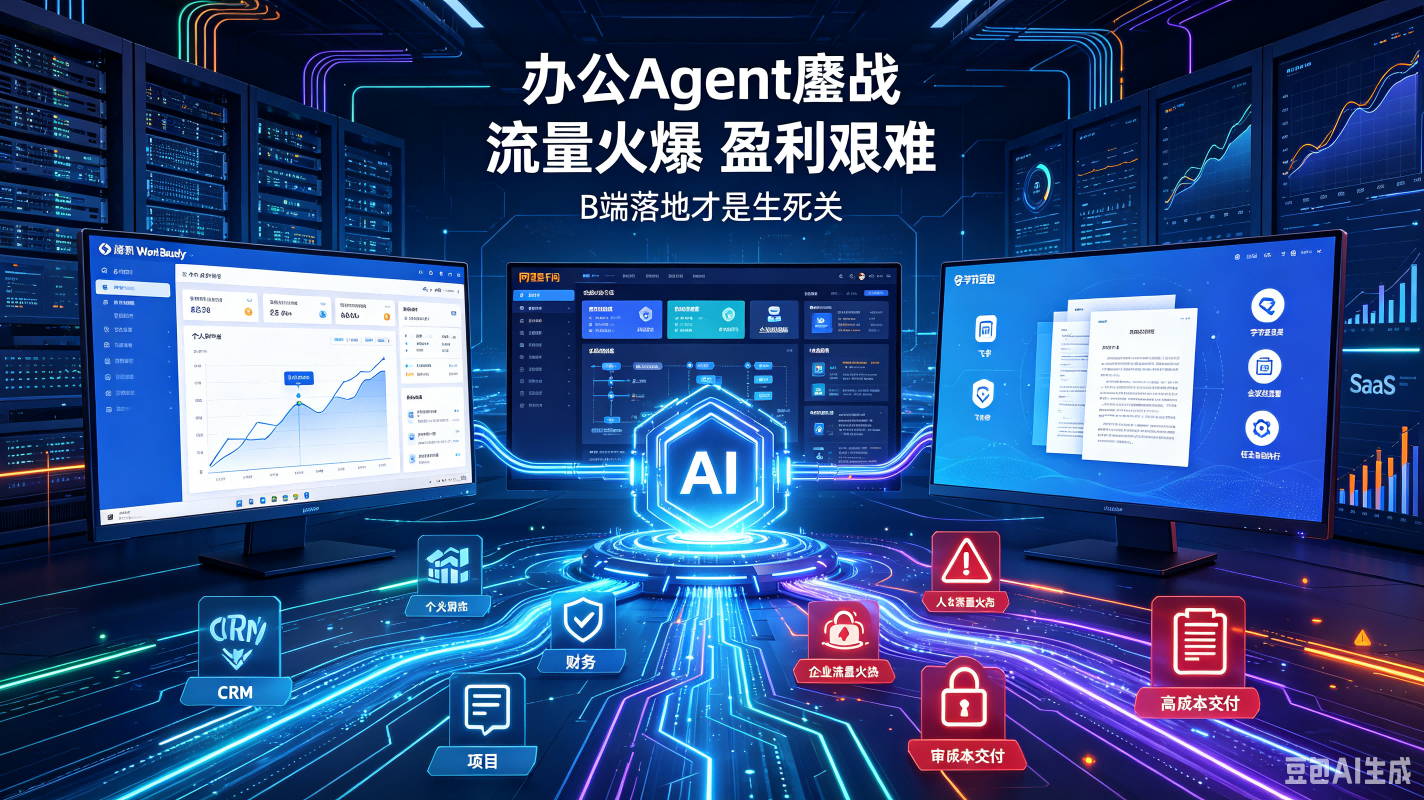
Just six months ago, AI agents were everywhere. Now, Tencent, Alibaba and ByteDance have all consolidated their AI office agent product lines. Consumer usage continues to climb, but beneath the hype, a deeper commercialization problem is becoming increasingly visible:
Free consumer traffic is proving difficult to convert into stable enterprise revenue. Office Agents are still far from becoming a mature, large-scale business.
The industry's core contradiction is coming into focus: what works for an individual does not necessarily work for an enterprise. The long-term ceiling of the market will depend on whether AI agents can connect organizational data, permissions and workflows — and operate safely within real business processes.
China's three major internet giants have consolidated their organizations and products around three distinct approaches to the AI office market.
Tencent's WorkBuddy has emerged as a leading desktop AI agent. Monthly PC visits surpassed 20.97 million in June, with the product focused on multi-model compatibility and the ability to execute tasks across desktop applications.
Backed by the WeCom ecosystem, WorkBuddy is targeting a broad range of administrative and operational users. Its individual paid plans range from RMB 99 to RMB 999, using product experience to capture consumer mindshare.
Alibaba officially opened Qwen Office for public beta testing on August 3, integrating three previously separate agents — QoderWork, Wukong and MuleRun.
With DingTalk's CEO overseeing the initiative, the product is positioned toward government and enterprise customers. Enterprise seats are priced at RMB 198 per month, with more than 30 built-in system connectors designed to facilitate enterprise data collaboration and workflow standardization.
At the end of July, ByteDance integrated the Feishu product team into Doubao, bringing its workplace collaboration capabilities closer to its core AI business.
The company has also paired TRAE with TRAE Work to expand its productivity offering. With professional plans starting at RMB 68, the strategy leverages Feishu's existing enterprise customer base to penetrate small and midsize teams.
ByteDance subsequently launched Doubao Work, combining workplace agents with Feishu and positioning AI agents as a new interface for getting work done.
On the consumer side, the numbers look impressive.
But the industry's core problem remains difficult to ignore: individual users tend to make small purchases or run short-term trials, while large-scale and recurring enterprise contracts remain limited. Public disclosure around paid conversion, renewals and customer lifetime value is also scarce.
The contrast with overseas players is striking. Microsoft 365 Copilot has surpassed 30 million paid seats, demonstrating that enterprise AI can move beyond experimentation toward large-scale paid deployment.
Office Agents face an inherent mismatch between users and buyers:
Employees use the tools. Enterprises pay the bills — and take on the risks.
For these products to become large businesses, they must move from consumer experimentation to enterprise-budget purchasing. Four major barriers stand in the way.
Customer, financial and operational data are often scattered across multiple systems.
An AI agent relying only on public or isolated information may be able to generate a polished document, but that output cannot necessarily be used directly in formal business processes. Aligning data across departments can also be extremely costly.
When an agent handles multi-step workflows and repeatedly calls external tools, its compute consumption can be several times higher than that of a single request.
As these agents operate continuously, inference and token costs can quickly become a significant enterprise expense.
Agents can potentially read and write files, access systems and execute business operations.
A single incorrect action can therefore propagate through an entire workflow. Enterprises need granular authorization, comprehensive audit trails and clearly defined boundaries for what an agent can and cannot do.
For many domestic products, enterprise-grade governance remains a work in progress.
Every enterprise has different workflows, data structures and business rules.
That makes implementation highly customized. Long deployment cycles and limited template reuse make it difficult for vendors to achieve the kind of marginal economics associated with traditional SaaS.
Overseas banks offer a useful reference point.
BBVA has reportedly taken a phased approach to rolling out ChatGPT Enterprise, while JPMorgan Chase has prioritized a unified security gateway before granting deeper access.
Enterprise AI adoption is therefore likely to be a gradual, permission-by-permission process — not something that can be scaled overnight.
The competition is no longer simply about whose model is smarter.
Two underlying architectural layers increasingly determine whether an AI agent can actually work inside an enterprise.
An agent harness is responsible for breaking down tasks, maintaining state, tracking progress and validating results.
A strong harness can significantly reduce the cost and complexity of debugging long-running enterprise workflows.
Anthropic, for example, has demonstrated how optimizing its agent framework can dramatically reduce system-prompt overhead while maintaining performance.
This layer manages user seats, knowledge bases, permissions, audit logs and cross-department access.
Tencent Cloud, Alibaba Cloud and Volcano Engine are all expanding capabilities in this area.
This is becoming one of the clearest dividing lines between an AI tool and an enterprise system.
Industry research suggests that only 16% of enterprises have successfully deployed agents across multiple departments, while 46% of vendors identify system integration as their biggest obstacle.
Cloud providers and workplace collaboration platforms have a structural advantage because they already control enterprise data, identities and permissions.
Purely consumer-oriented agents, by contrast, may remain primarily personal productivity assistants unless they can penetrate core business workflows.
For investors and industry observers, two metrics may ultimately determine whether office Agents can evolve into a truly large-scale business.
Are AI agents actually participating in financial reporting, order processing, project management and other formal business operations?
Or are they still primarily being used to draft documents, summarize information and organize materials?
The difference is critical.
When a new enterprise customer comes on board, can the vendor reuse proven industry templates and deployment frameworks?
Or does every customer require another round of expensive customization?
The former creates SaaS-like economies of scale. The latter creates a services business with limited scalability.
For now, major technology companies can use free quotas, aggressive promotions and consumer distribution to generate enormous traffic.
But traffic is not revenue.
The next phase of the AI office-agent race will be defined by something much harder: connecting enterprise data, permissions, compliance and workflows, then embedding AI agents into the actual machinery of organizational production.
The companies that can make that transition may turn office Agents into sustainable enterprise businesses.
Those that remain stuck at the level of personal desktop tools may find their commercial ceiling much lower.
Risk Disclaimer: This article provides an objective overview of industry developments and does not constitute investment advice or a recommendation regarding any industry or individual stock.

AI Market Research & Consumer Insights Provider
China's Leading Treasury Management Software Provider
AI落地解决方案及数字化创新服务提供商
A high-tech enterprise integrating product design, R&D, sales, and services.
Leading full-scenario data intelligence service provider in China.