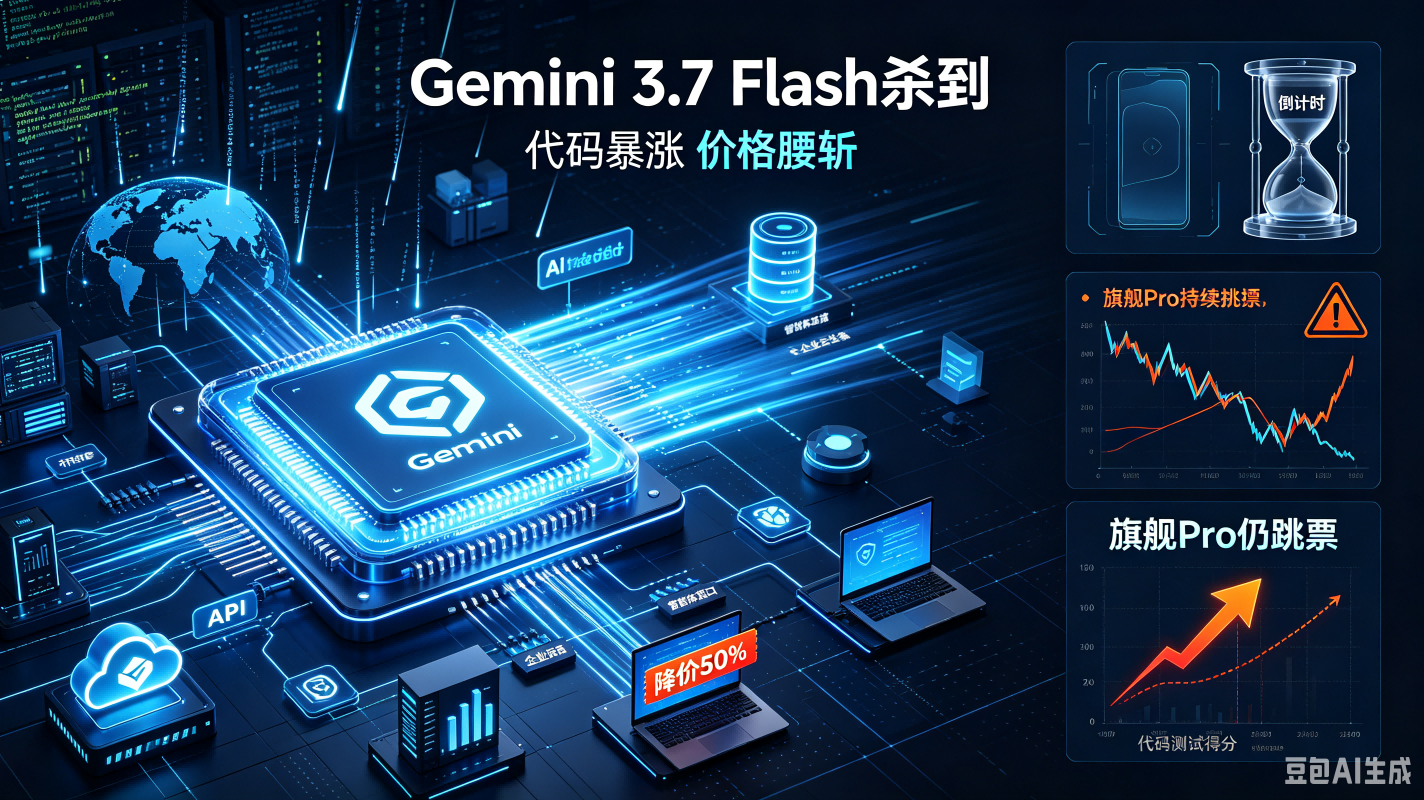
On August 13, U.S. Eastern Time, Google moved quickly to launch Gemini 3.7 Flash, just three weeks after the previous-generation 3.6 Flash, accelerating its push into mid-tier work models.
The new release focuses on three core areas: coding, multi-step AI agents, and complex enterprise workflows — while cutting token prices by roughly half.
Meanwhile, the highly anticipated flagship Gemini 3.5 Pro still has no confirmed release date.
The contrast is striking: Flash is moving fast, while Pro remains in limbo. And that is continuing to raise questions about Google's competitiveness at the high end of the AI model market.
The biggest upgrades in 3.7 Flash target developers' most practical engineering needs.
Rather than focusing primarily on generating simple code snippets, the model is designed to handle debugging, end-to-end software projects, and multi-tool execution.
Google's reported benchmarks show substantial gains over the previous generation:
FrontierCode: 34.4% → 43.6% on production-code tasks
DeepSWE: 49.0% → 65.3% on long-horizon software engineering
Web development: Elo score increased by 50 points to 1,588, surpassing several major competitors
The model also reportedly improves autonomous planning across multi-step tasks and automated error recovery, reducing the need for human intervention during complex development and workplace workflows.
That makes it particularly suited to large-scale AI agent automation.
Google has also strengthened safeguards around cybersecurity and data-risk scenarios to reduce potential misuse.
Gemini 3.7 Flash is now available through Google AI Studio and Android Studio, while Gemini Spark's workplace agent has also moved to the new model.
Pricing may be the most aggressive part of the launch.
Under a limited-time promotional offer through the end of 2026:
Input: $0.75 per million tokens — roughly half the previous price
Output: $3.75 per million tokens — also around 50% lower
Pricing is expected to return to standard levels in 2027.
Compared with comparable models from Anthropic and OpenAI, Google's pricing is designed to make Flash particularly attractive to developers and enterprises looking to deploy AI agents at scale.
The launch also comes as Google rapidly expands its Flash lineup.
In July, the company introduced multiple variants, including 3.6 Flash, the lightweight 3.5 Flash-Lite, and the security-focused 3.5 Flash Cyber.
Together, they cover different use cases — from high-throughput and low-latency workloads to coding and security — giving Google a broader mid-range model portfolio.
The strategy is straightforward:
Iterate faster, lower the cost, and capture more of the developer ecosystem.
Behind the rapid expansion of Google's mid-range lineup is a very different story at the flagship level.
The highly anticipated Gemini 3.5 Pro, originally expected around mid-year, still has no confirmed public release date. Reports indicate that it remains in limited testing with internal and external partners.
The reported reason for the delay is that its coding and long-form reasoning capabilities have yet to meet Google's internal standards.
The delay has also intensified market concerns about Google's position in the high-end AI race.
OpenAI and Anthropic continue to push specialized coding models, with Claude Code and Codex becoming increasingly prominent developer tools.
Without a new flagship model, Google faces a gap at the premium end of the market — an area where Flash alone may struggle to compete for high-value enterprise deployments.
Google has meanwhile confirmed that the next-generation Gemini 4 has entered large-scale pre-training.
But that is a longer-term bet.
It does little to solve the immediate competitive pressure facing Gemini at the high end.
The recent product cadence reveals a fairly clear strategy.
1. Use Flash to secure the infrastructure layer
Lower prices and stronger coding capabilities allow Google to target developers and smaller businesses, expand AI agent and workplace automation use cases, and increase API adoption.
2. Slow down the flagship race while strengthening commercialization
Google CEO Sundar Pichai has emphasized the company's growing focus on work-oriented AI models and practical applications, with Google Cloud, developer tools, and its broader mobile ecosystem providing channels to turn AI investment into commercial value.
3. Build toward Gemini 4
At the same time, Google is investing heavily in the next generation of models, hoping Gemini 4 can eventually close the gap at the high end.
The broader AI market is increasingly splitting into two battles.
In the short term, commercial adoption is increasingly about cost, speed, and practical performance.
In the long term, technological leadership still depends heavily on frontier models.
Google's Flash strategy could help it expand its developer footprint quickly.
But until Gemini's flagship lineup catches up, the question at the top of the market remains open.
For Google, the next flagship release may matter far more than the next Flash update.

AI Market Research & Consumer Insights Provider
China's Leading Treasury Management Software Provider
AI落地解决方案及数字化创新服务提供商
A high-tech enterprise integrating product design, R&D, sales, and services.
Leading full-scenario data intelligence service provider in China.