GPT Image 2 only arrived four months ago, after reportedly crushing Nano Banana Pro in head-to-head tests. It barely had time to settle in before a new model from its own house came knocking.
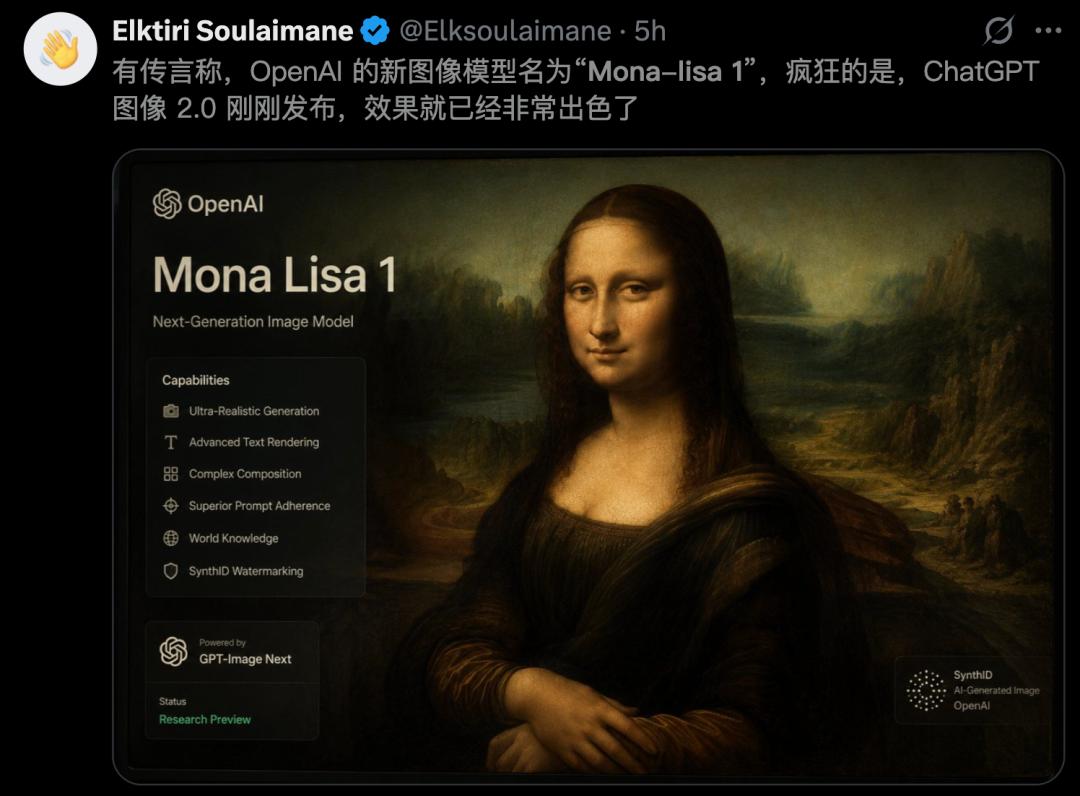
Early hands-on tests have left users stunned. Mona-lisa-1 appears to outperform GPT Image 2 by a visible margin, delivering significantly more realistic images and seemingly addressing one of AI image generation’s longest-running problems: that unmistakable “plastic” look.
Mona-lisa-1 initially appeared on the Arena platform as an anonymous model.
Then developer @AiBattle_ ran one of its generated images through OpenAI’s official verification tool — and the image reportedly came back with an OpenAI SynthID watermark.
That discovery immediately fueled speculation that the mysterious model could be another unreleased OpenAI system.
Based on the comparison images circulating online, mona-lisa-1 appears to outperform GPT Image 2 across fine-grained detail, lighting depth and overall visual atmosphere, whether generating portraits or recreating works of art.
In one side-by-side test, a developer fed the exact same prompt into both models to generate a photorealistic Ultraman image. Mona-lisa-1 reportedly delivered a substantial jump in realism, with more natural skin tones, textures and transitions between light and shadow.
It also performed strongly on more demanding information-heavy generations.
One test produced a remarkably realistic web UI directly from a prompt, while a highly detailed anatomical illustration proved little challenge. The model could even reproduce Einstein’s handwriting convincingly in a finished image.
Some developers have noticed another intriguing detail: mona-lisa-1 may have been trained as early as last year.
In five consecutive date-related tests, the model reportedly gave answers that remained anchored in 2025 — roughly matching the knowledge cutoff associated with GPT Image 2 in the tests.
That has led some developers to speculate that mona-lisa-1 could be a new checkpoint built on the same-generation foundation, rather than an entirely new model architecture.
After multiple rounds of testing, one emerging description is particularly telling:
“It feels like an Image 2.5 — just the mid-sized version.”
And then there is the “-1” at the end of the codename.
That tiny suffix may be the biggest clue of all.
If mona-lisa-1 is indeed only an intermediate checkpoint, OpenAI could have more iterations in the pipeline. The eventual production release may therefore represent another significant jump in image-generation quality.
Look back at the trajectory of GPT Image 2.
The model launched in April, quickly climbing to the top of Image Arena thanks to its strong text rendering, instruction following and multi-image composition capabilities. In text-to-image rankings, it reportedly led the runner-up by 242 points.
OpenAI CEO Sam Altman described the leap at the time as a “caveman paintings to Renaissance” moment.
Now, just four months after GPT Image 2 reached the top, OpenAI appears to be testing a model that could challenge its own benchmark.
For ordinary users, the biggest promise of mona-lisa-1 may be surprisingly simple:
AI-generated images are starting to look less obviously AI-generated.
The overly smooth skin, artificial lighting and unmistakable “AI look” that once gave generated images away are increasingly being replaced by more convincing textures, subtler lighting and more natural visual imperfections.
For competitors, meanwhile, the message is equally clear:
Just when you catch up to GPT Image 2, OpenAI may already be moving the goalposts again.
The next question is when OpenAI will officially reveal what exactly Mona Lisa is.
At this pace, by the time the production version finally arrives, the ceiling for AI image generation may have moved yet again.

AI Market Research & Consumer Insights Provider
China's Leading Treasury Management Software Provider
AI落地解决方案及数字化创新服务提供商
A high-tech enterprise integrating product design, R&D, sales, and services.
Leading full-scenario data intelligence service provider in China.