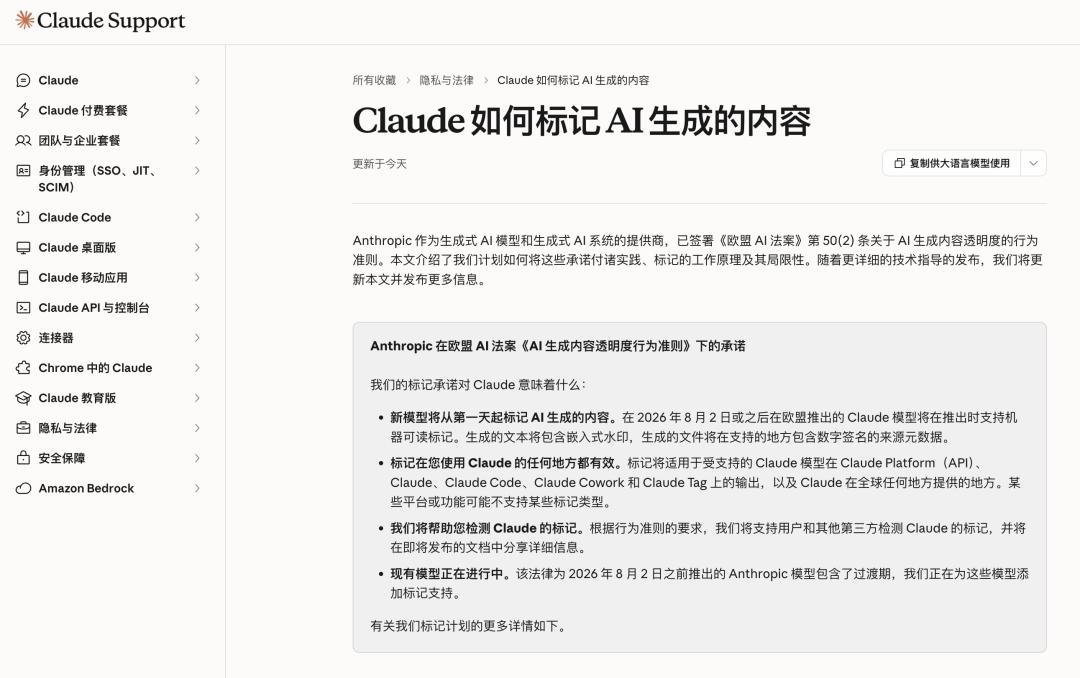
Starting August 2, newly launched Claude models will carry an invisible, machine-readable mark in every piece of generated text.
Copy and paste won’t necessarily remove it. Even some forms of editing may leave the mark intact.
Anthropic has formally outlined the initiative as part of its implementation of Article 50 of the EU AI Act, which introduces transparency requirements for AI-generated content. But Anthropic is going further than simply complying within the EU: the company says its marking system will apply globally wherever supported Claude models are available.
Anthropic is using two complementary mechanisms to mark AI-generated content.
When a supported Claude model generates text, it introduces an imperceptible statistical pattern directly into the text during token selection.
You cannot see it, and Anthropic says it does not change the meaning, quality or readability of Claude's output. The watermark is embedded at the model level rather than stored as external metadata.
That means it can travel with the text when it is copied and pasted elsewhere, and may survive some forms of editing.
The underlying approach is based on a simple idea: when a model has several equally reasonable ways to choose its next word, the watermark subtly influences those low-stakes choices according to a predefined statistical pattern.
To the human eye, nothing changes.
But a detector with the right key can analyze enough of those choices to estimate whether Claude was likely involved in producing the text.
Anthropic says its implementation is based on the SynthID-Text approach developed by Google DeepMind. The company has not disclosed every technical detail of its implementation.
For supported file types such as .svg, .png and .jpg, Claude can attach digitally signed provenance metadata based on the C2PA open standard.
Unlike the text watermark, this is not hidden inside the content itself. Instead, the metadata records that Claude was involved in creating or processing the file and can help detect whether the file has subsequently been tampered with.
The two systems therefore operate at different levels:
Text watermark → model-level marking applied to generated text
C2PA metadata → file-level provenance for supported formats
The EU AI Act is focused on AI systems placed on the European market. Anthropic, however, has chosen to apply its marking system globally.
According to Anthropic, supported models will carry these marks across Claude Platform (API), Claude, Claude Code, Claude Cowork and Claude Tag, wherever Claude is available worldwide. Supported Claude models accessed through AWS, Google Cloud and Microsoft Foundry will also carry watermarks.
The key date is August 2, 2026.
Claude models launched in the EU on or after that date are required to support machine-readable marking from launch. Models released before August 2 fall under a transition period, and Anthropic is working to add marking support to those older models.
Anthropic has also begun rolling out a watermark detection API in private preview, initially for eligible organizations such as regulators, law enforcement, media organizations, fact-checkers, researchers and certain enterprises. Wider access is planned over time.
Anthropic is unusually explicit about what its watermark cannot prove.
Users may ask Claude to proofread, translate, summarize or reformat content they originally created themselves.
The resulting output may carry a Claude watermark even though the underlying ideas or data came from the user.
In other words:
A detected watermark means Claude was likely involved — not necessarily that Claude created the original content.
Anthropic lists several reasons why a Claude-generated passage may no longer produce a detectable signal:
It was generated by an older model without watermark support.
The text was heavily edited, rewritten, translated or mixed with other material.
The passage is too short to provide enough statistical signal.
File metadata was removed through format conversion, re-saving or screenshots.
The relevant platform or file type does not support that particular marking method.
Anthropic also acknowledges that a complete rewrite can defeat the watermark. Light editing may leave enough of the signal intact, while replacing essentially every word can remove it.
Anthropic is among the first major AI companies to deploy text watermarking at this scale.
Google DeepMind has already developed SynthID for multiple forms of AI-generated content, while other major AI providers have also committed to implementing marking systems under the EU's transparency framework.
The move is already raising questions among users.
For people who use Claude to draft emails, prepare internal documents, translate text or generate content for publication, AI involvement could increasingly become machine-detectable even after the content leaves the original platform.
But the real value of watermarking will depend on two things:
How reliably can the mark be detected?
And how widely will detection tools actually be available?
Embedding the signal is only half the equation. Detection accuracy, resistance to editing and access to verification tools will determine whether AI watermarking becomes meaningful transparency infrastructure — or simply another compliance mechanism.
Anthropic's detection API is still in private preview, and the company says it plans to expand access over time.
One thing is becoming clear:
The era of AI-generated content leaving no trace is beginning to change.

AI Market Research & Consumer Insights Provider
China's Leading Treasury Management Software Provider
AI落地解决方案及数字化创新服务提供商
A high-tech enterprise integrating product design, R&D, sales, and services.
Leading full-scenario data intelligence service provider in China.