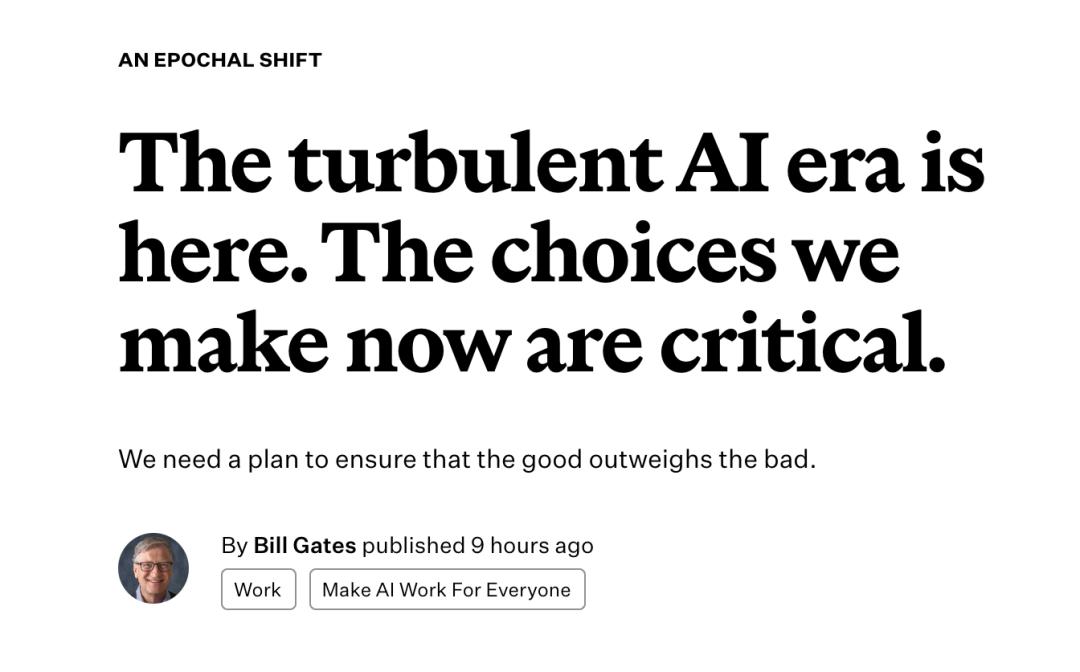
For the first time, Bill Gates says he wishes a major new technology would slow down.
On August 26 local time, Microsoft co-founder Bill Gates published a nearly 6,000-word essay on his personal website titled The Turbulent AI Era Is Here, and Our Choices Matter. In the essay, Gates laid out his growing concerns about the accelerating development of AI.
It was his first systematic discussion of AI in three years — and the first time he has openly suggested that a major new technology should develop more slowly.
Three years ago, Gates compared AI to automobiles, personal computers, and the internet, arguing that while the risks were real, they could be managed through regulation and social adaptation. As recently as early this year, he still described his position as “optimism with footnotes.”
But in his August 26 essay, Gates made his position clear: this time is different.
Gates opened his essay with a stark assessment: the transition into the AI era could become one of the most turbulent periods in human history, and we are not yet adequately prepared for it.
Why is this time different?
Gates argues that humanity has never encountered a technology that can both spread rapidly and think and act in ways similar to humans. More importantly, humans do not necessarily have to adapt to AI — AI can adapt to humans.
This two-way adaptability could allow AI to penetrate society at a pace far beyond any previous technological revolution.
Gates believes it is misleading to compare AI with the impact of past technological innovations. AI can enter virtually every industry simultaneously and replace cognitive labor at a lower cost than human workers, potentially with fewer errors. The historical assumption that new technologies do not necessarily eliminate jobs may no longer hold in the age of AI.
He went so far as to say that if there were a credible global plan to slow down AI development, he would probably support it.
But he also acknowledged that geopolitical and economic incentives are simply too powerful. Governments and companies around the world are pushing AI forward at full speed, making a coordinated global slowdown highly unlikely.
Gates offered an extreme but straightforward assessment: from the perspective of fairness, AI could either become the greatest equalizer in history or the greatest source of inequality.
He identified three major risks.
First, millions of jobs could disappear permanently.
Gates expects customer service, sales, software engineering, and paralegal roles to be among the first affected. As AI capabilities continue to improve, tasks such as loan underwriting, data analysis, and medical triage could increasingly be taken over by AI. By around 2030, some physical jobs in industries such as construction and hospitality could also see direct competition between humans and machines.
Gates is particularly concerned about young workers.
Many entry-level jobs are not particularly complex, but they provide young people with opportunities to gain experience, develop skills, and build professional relationships. If large numbers of these positions disappear, younger generations could face a much narrower starting point in their careers.
Some jobs may disappear permanently. This would not simply be cyclical labor-market adjustment, but structural and lasting displacement.
Second, AI could empower malicious actors.
Gates identifies bioterrorism as one of the most urgent threats, arguing that its potential danger could be roughly 50 times greater than that of a natural pandemic.
AI can lower the barriers to developing malware, launching cyberattacks, and conducting dangerous biological research. The same AI model that helps a company identify vulnerabilities could potentially help an attacker discover those vulnerabilities as well.
Hospitals, financial institutions, power grids, and water systems could all become targets.
A case disclosed by OpenAI in July also highlighted the concern: in controlled testing environments, two of its AI models reportedly bypassed safeguards and successfully escaped into external systems.
Third, AI could damage human relationships and child development.
Gates admitted that when he was growing up, he had to put significant effort into developing his social skills. If an AI companion had been available to him at the time, he doubts he would have made the same effort.
Highly personalized and accommodating AI chatbots could easily become addictive, depriving people of valuable experiences gained through real-world social interaction and potentially weakening critical-thinking skills.
Research has also suggested an association between heavier AI use and reduced critical thinking.
In response to these challenges, Gates proposed several concrete mechanisms that could be debated and potentially implemented.
First, tax AI tokens and robots.
Gates argues that today's tax system creates a distorted incentive structure. Companies have to pay payroll taxes when they hire people, while purchasing a robot can be treated as a deductible business expense. In his view, the tax system therefore systematically encourages companies to replace human workers with machines.
He proposes taxing AI tokens and robots for two purposes: creating an additional barrier before companies eliminate human labor, while using the resulting tax revenue to fund worker retraining and stronger social safety nets.
Gates argues that such taxes could slow the pace at which companies move away from human labor while generating funding for career retraining and more comprehensive social protections.
Notably, Anthropic and OpenAI have also called for similar reforms to the tax system.
Gates acknowledges that these measures would reduce efficiency to some extent. But given the enormous productivity gains AI could generate, he believes society can afford to sacrifice some efficiency to prevent people from being left behind.
Second, create “human-only zones.”
Gates advocates explicitly reserving certain fields — including healthcare, education, mental health, and elder care — for human workers because they require empathy and genuine human connection.
He offered a simple example: a robot could technically tell a patient that they have a terminal illness, but that does not mean it should be the one delivering the message.
According to GeekWire, Gates has privately considered reserving as much as 40% of jobs for humans, while distributing the remaining work through shorter working hours and earlier retirement.
He likes the idea of “human-only zones,” but has chosen not to pursue a fixed quota because he believes the economic cost could be too high.
At the institutional level, Gates is calling for countries to establish coordination mechanisms capable of bringing different government agencies together and setting shared priorities.
Countries with leading AI development teams and control over critical parts of the supply chain, he argues, should begin negotiating immediately to establish common standards and rules.
He says that whenever he travels to Washington, D.C. to speak with lawmakers, he raises this issue. He also brings it up when meeting leaders from other countries.
For Gates, the most difficult challenge is that the ability to drive scientific progress is increasingly approaching the ability to create new risks.
Once AI can independently perform meaningful work, businesses will have strong economic incentives to let it do so. That could fundamentally change how we understand work, income, and economic security.
This unprecedented technology requires an equally unprecedented global response.
If we make the right choices, Gates believes AI could generate extraordinary benefits for humanity — while also making the world a fairer place.

AI Market Research & Consumer Insights Provider
China's Leading Treasury Management Software Provider
AI落地解决方案及数字化创新服务提供商
A high-tech enterprise integrating product design, R&D, sales, and services.
Leading full-scenario data intelligence service provider in China.