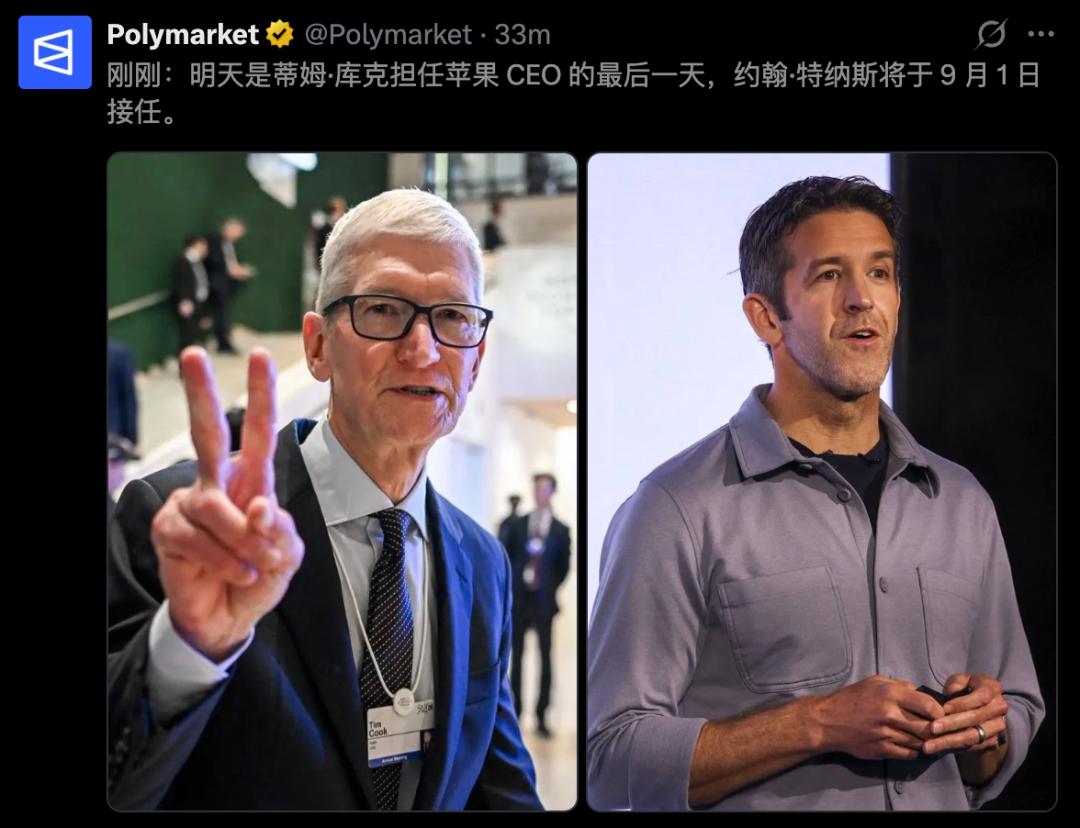
At 51, hardware engineering veteran John Ternus officially took the reins. The historic transition had been in the making for two years. Cook is not leaving Apple entirely; he will become executive chairman of the board, continuing to handle responsibilities such as engaging with policymakers around the world. On Weibo, he wrote: “On my final day as Apple CEO, I’m sending so much love to the Apple community. Tomorrow, my title will change, but my love for the Apple community never will.”
A week earlier, on August 23, Apple hosted a farewell party for Cook at Apple Park, attended by around 200 employees and guests.
When Cook took over from Steve Jobs in August 2011, Apple generated roughly $108 billion in annual revenue and had a market capitalization of around $350 billion. Fifteen years later, annual revenue had surpassed $416 billion, while its market cap had ballooned to $4.6 trillion. Cook did not try to replicate Jobs’ path. Instead, he pushed his greatest strength—operational excellence—to the extreme, turning Apple into a precision-engineered, highly efficient cash machine.
The Apple Watch and AirPods became runaway hits, while the Services business grew from roughly $9 billion into a new pillar generating more than $100 billion a year. But there were setbacks too. HomePod never took off. Apple’s decade-long car project, which burned through billions of dollars, was shut down in 2024. The much-hyped Vision Pro has yet to gain meaningful commercial traction. And Apple’s lag in AI has emerged as its biggest source of uncertainty.
Ternus joined Apple in 2001 as a Mac design engineer and went on to lead the engineering behind the iPad, AirPods, and much of Apple’s broader hardware portfolio. He is a quintessential Apple product builder. But his experience in areas such as finance, sales, and government relations is relatively limited, meaning he will likely rely more heavily on Apple’s existing leadership team.
He inherits an Apple that is close to flawless when it comes to products, supply chains, and customer services—but the challenges are just as formidable: How quickly can Apple catch up in AI? And where will its next major growth engine come from in an increasingly saturated market?
Apple has clearly fallen behind in AI over the past three years. After stumbling with its own foundation models, the company turned to Google’s Gemini to power the next generation of Siri. Its former AI chief, John Giannandrea, departed in April. Apple Intelligence has fallen short of expectations, while Siri upgrades have been delayed repeatedly. In August, Apple also laid off more than 200 employees from its AI teams.
Ternus’ solution is clear: embed AI deeply into Apple’s hardware ecosystem. Camera-equipped AirPods could understand their surroundings. Smart glasses could bring Siri directly into the user’s field of view. A smart home display could recognize who is speaking and tailor content accordingly. Internally, Ternus is also pushing the use of AI to improve product development and hardware testing.
The AI battle will play out on two fronts: externally, giving Apple hardware new perceptual capabilities; internally, using AI to accelerate the product development cycle.
Ternus has virtually no transition period. On September 9, he will host Apple’s fall launch event for the first time as CEO, with the most anticipated product being Apple’s first foldable iPhone Ultra.
The foldable iPhone is also expected to be Apple’s most AI-intensive iPhone yet. A new Siri AI will offer personal-context awareness, screen understanding, and cross-app actions. Other new products, including a smart display capable of recognizing individual speakers, are also expected to make their debut.
For Ternus, September 9 is more than a product launch. It is his first major opportunity to prove to the world that Apple can still lead innovation in the AI era.
Cook’s era has come to an end. Ternus’ AI expedition has only just begun.

AI Market Research & Consumer Insights Provider
China's Leading Treasury Management Software Provider
AI落地解决方案及数字化创新服务提供商
A high-tech enterprise integrating product design, R&D, sales, and services.
Leading full-scenario data intelligence service provider in China.